Fitted Wardrobe Cost UK 2026: Bespoke, Built-In & Made to Measure Prices
Written by Tom Ellis · Senior Trades Editor
Last updated: July 2026
Quick Answer
Fitted wardrobes in the UK cost between £350 and £1,800 per linear metre installed, depending on material and specification. A standard 3-metre double bedroom wardrobe with sliding doors costs £1,200 to £2,500 for a mid-range MDF finish. Bespoke solid hardwood wardrobes with full interior fitment run £3,500 to £6,000 or more for the same footprint.
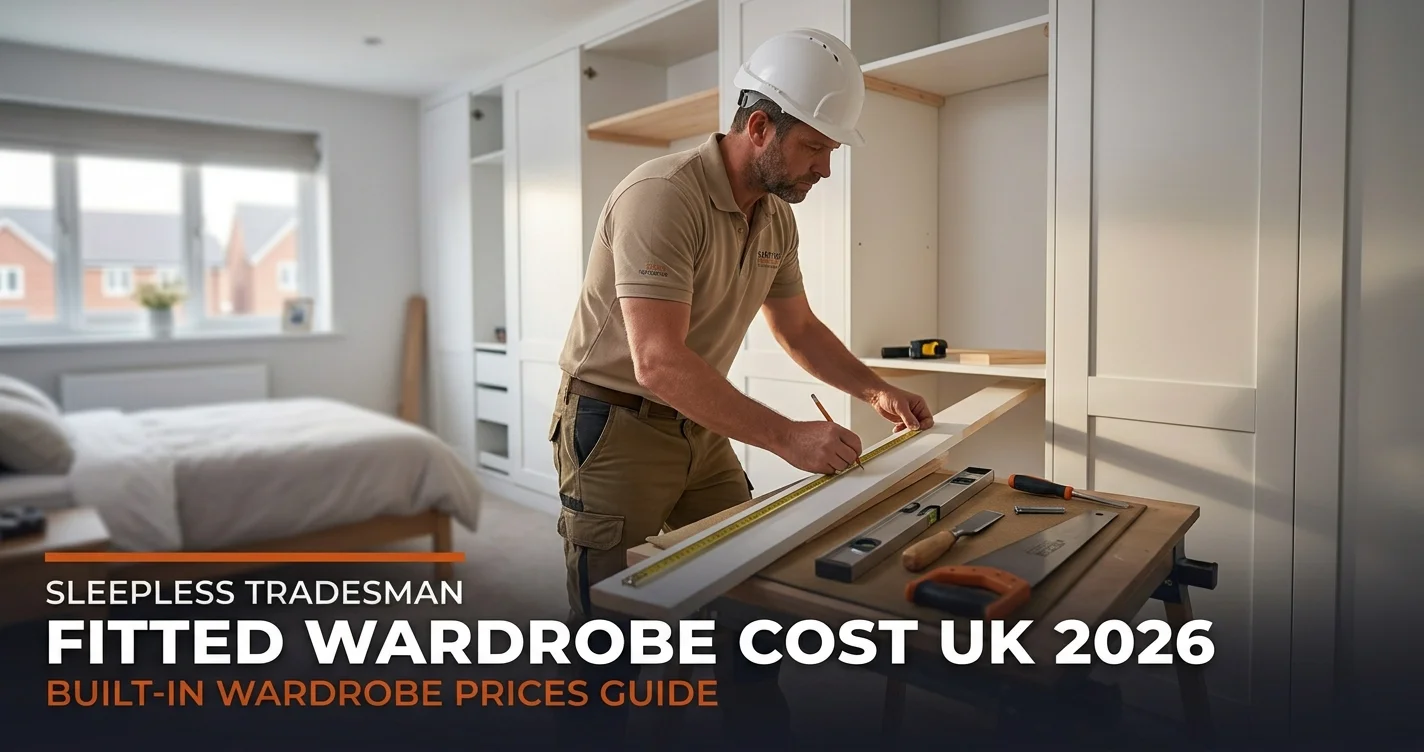
Fitted Wardrobe Cost per Linear Metre UK 2026
The table below shows typical supply and fit prices per linear metre for the most common wardrobe types in the UK. All prices include materials and installation by a joiner. London and South East prices are typically 20 to 30 percent higher than the figures shown.
| Type | Per linear metre | 3m wardrobe (total) | Notes |
|---|---|---|---|
| Basic MDF sliding doors | £350 – £550 | £1,050 – £1,650 | Single rail, painted finish |
| Mid-range MDF hinged doors | £550 – £800 | £1,650 – £2,400 | Drawers and shelving included |
| Mirror-front sliding doors | £600 – £900 | £1,800 – £2,700 | MDF carcass, mirrored panels |
| Shaker-style painted MDF | £600 – £900 | £1,800 – £2,700 | Applied moulding door fronts |
| Built-in alcove wardrobe | £400 – £700 | £400 – £900 (1–1.5m) | Uses existing walls as sides |
| Bespoke solid hardwood | £1,000 – £1,800 | £3,000 – £5,400 | Oak, walnut or ash doors |
| Walk-in wardrobe fit-out | – | £3,000 – £15,000+ | Priced per room, not per metre |
Prices are supply and fit, including materials and joiner labour. Interior accessories such as additional drawers, integrated lighting, and pull-out rails are charged separately — see the interior fitment section below.
What Affects the Cost of Fitted Wardrobes?
The main variables that drive the cost of fitted wardrobes are the size (total linear metres), the material (MDF versus solid hardwood), the door type (sliding versus hinged), the interior fitment (simple rail and shelf versus drawers and pull-out accessories), and the finish (paint, veneer, or stained hardwood). A basic 2.4-metre wardrobe with sliding doors and a single hanging rail is a very different proposition from a 4-metre L-shaped bespoke wardrobe with full-height panelling, soft-close drawers, and integrated lighting.
Size is the most obvious cost driver. Joiners typically quote fitted wardrobes per linear metre, which makes it straightforward to compare quotes, provided the spec is the same. A wardrobe that runs the full width of a typical UK master bedroom (3 to 3.6 metres) will cost more than one that fits a single alcove, but the price per metre often comes down slightly on larger jobs because the setup time and door mechanisms are spread across more material.
Labour is a significant portion of the total. An experienced joiner charges between £200 and £350 per day in most parts of the UK, and a straightforward 3-metre sliding door wardrobe takes roughly two days from start to finish. In London and the South East, day rates are higher, and the total cost of a fitted wardrobe can be 20 to 30 percent above the national average. If you are comparing quotes and want a benchmark for joinery day rates, see our carpenter and joiner day rate guide for 2026.
The complexity of the room also matters. Rooms with chimney breast alcoves, irregular corners, or non-standard ceiling heights require more cutting, scribing, and fitting time. The same is true for rooms in older properties where walls are not plumb or floors are not level. A good joiner will account for this during the survey, but it is worth discussing upfront to avoid surprises once work starts.
Finally, the choice of handles, drawer runners, and soft-close mechanisms adds up. Even on a mid-range wardrobe, premium handles can add £100 to £300 to the total. Soft-close drawer runners and hinges are worth specifying if longevity matters, particularly for drawers that will be used frequently.
Fitted Wardrobe Costs by Type UK 2026
Sliding door wardrobes are the most common choice for UK bedrooms, particularly in newer builds where floor space is limited. The doors slide on a top-hung or bottom-rolling track, which means you do not need clearance in front of the wardrobe for the doors to open. A basic MDF sliding door wardrobe measuring 2 to 3 metres wide costs £900 to £1,800 supply and fit. Mid-range units with mirror-fronted sliding doors cost £1,500 to £2,500 for the same footprint. Mirrored doors are popular because they double as a bedroom mirror and make a room feel larger, which is particularly useful in smaller rooms.
Hinged door wardrobes are slightly cheaper than sliding door units because the door mechanism is simpler and there are no tracks to install. A 3-metre hinged door wardrobe costs £1,200 to £2,000 supply and fit. The trade-off is that you need clear floor space in front of the wardrobe for the doors to swing open, which makes hinged door wardrobes less suitable for small bedrooms or rooms with beds positioned close to the wardrobe. That said, hinged doors give full-width access to the wardrobe interior in one go, which some people prefer.
Alcove wardrobes take advantage of the recesses that are common in older UK properties, particularly Victorian and Edwardian terraces where chimney breasts create natural alcoves on either side. When a wardrobe fits into an alcove, the cost is lower because two walls are already in place and act as the sides of the unit. An alcove wardrobe 1 to 1.5 metres wide costs £400 to £900 supply and fit with a hinged door and basic interior. If the alcoves on both sides of a chimney breast are fitted simultaneously, most joiners will offer a small discount on the combined job.
Walk-in wardrobes are priced differently, as they are more like a room fit-out than a single wardrobe unit. The walls of the space become the structure, and the joiner fits rails, shelves, drawers, and sometimes island units into the available footprint. A small walk-in wardrobe measuring 1.5 to 2 metres deep and 2.5 to 3 metres wide typically costs £3,000 to £8,000 to design, build, and fit out. Larger walk-in wardrobes with full-height panelling, integrated lighting, and pull-out accessories can reach £15,000 or more.
For tradesmen pricing joinery work, understanding how different wardrobe types affect material and labour costs is important when putting together accurate quotes. Our guide to how to price joinery work in the UK covers the key principles for quoting fitted furniture alongside other joinery jobs.
Material Options and Their Costs
MDF (Medium Density Fibreboard) is the most common material for fitted wardrobes in the UK, and for good reason. It is dimensionally stable, takes paint well, and is significantly cheaper than solid timber. MDF wardrobes can be spray-painted to any RAL colour for a smooth, professional finish that is hard to distinguish from painted solid wood at a glance. Most high-street fitted wardrobe companies, as well as independent joiners working to a budget brief, use MDF as standard. A fully painted MDF wardrobe carcass and door fronts in a standard bedroom will cost less than the equivalent in solid wood by a factor of two to three.
Plywood is a less common but increasingly popular choice, particularly among joiners working on contemporary interiors. It is stronger and lighter than MDF, handles screws better (which matters for drawer runners and hinges), and is more resistant to humidity. This is relevant in bedrooms that adjoin an en-suite bathroom, where moisture levels can affect MDF over time. Plywood is harder to paint to a smooth finish without a lot of preparation, but it can be left with a natural birch face for a Scandinavian aesthetic. Expect to pay 10 to 20 percent more for a plywood carcass compared to MDF.
Solid hardwood, including oak, walnut, and ash, is the premium option. Solid hardwood wardrobes cost two to three times more than MDF equivalents but age well and can be sanded and refinished if they become scratched or worn. In practice, most bespoke wardrobe makers use solid timber for the door frames and visible carcass faces, with a plywood or MDF interior carcass for the shelves and internal structure. This keeps the cost somewhat lower while maintaining the look and feel of solid timber at the door face.
Board-and-batten or shaker style is a popular finish that uses flat-panel boards with applied mouldings to create a traditional shaker appearance. This can be done in MDF at mid-range cost, or in solid timber for a premium finish. Shaker-style wardrobes with painted MDF doors sit in the £600 to £900 per linear metre range installed, while solid timber shaker doors push the price up to £1,200 to £1,800 per linear metre or higher depending on the timber species and specification.
Bespoke and Made-to-Measure Wardrobe Costs UK 2026
The terms bespoke and made-to-measure are used interchangeably in the fitted wardrobe market, but they mean different things in practice. Made-to-measure wardrobes are built to the exact dimensions of your space using a system of standard components — carcasses, door panels, and interior fittings that come in fixed sizes and are cut to fit on site or in a workshop. Most mid-range fitted wardrobe companies operate this way. It is faster and cheaper than fully bespoke, and the result is a wardrobe that fits the room precisely.
Truly bespoke wardrobes are designed and built from scratch by a joiner or cabinet maker. Every component is made specifically for your space, using materials and specifications you choose from the outset. A bespoke wardrobe can follow unusual room geometry, incorporate unique design details, and use premium timber species that are not available in standard systems. The trade-off is cost and lead time. A bespoke fitted wardrobe built by a cabinet maker will cost £1,000 to £1,800 per linear metre installed, compared to £550 to £900 per linear metre for a made-to-measure MDF equivalent.
Lead times differ significantly. A made-to-measure wardrobe from a national supplier or a local joiner working with stock carcasses typically takes two to four weeks from survey to installation. A fully bespoke wardrobe made in a workshop from solid timber takes six to twelve weeks, particularly if the cabinet maker has a waiting list. For a bedroom renovation with a fixed timeline, confirm lead times before committing.
For most UK homeowners, made-to-measure MDF wardrobes in a painted finish represent the best value. They look bespoke in situ, fit the room exactly, and can be specified with the same interior accessories as a fully bespoke unit. The difference becomes more meaningful if you want solid timber for its longevity, or if the room has unusual geometry that a standard component system cannot accommodate.
If you are a joiner pricing bespoke fitted wardrobe work, the material markup and labour calculation is more complex than for a supply-and-fit job. Our guide to material markup for tradesmen covers how to price materials correctly to protect your margin on jobs where the specification varies significantly.
Fitted Home Office Furniture Costs UK 2026
Fitted home office furniture — built-in desks, shelving units, and storage cabinets — follows similar pricing logic to fitted wardrobes. The same joiner who builds bedroom wardrobes can typically design and fit a home office, and the cost per linear metre is comparable. A fitted desk with shelving above and a two-door cabinet below runs £800 to £1,500 for a 1.8 to 2.4 metre run in MDF, painted finish, supply and fit. Full-wall fitted office units with a mix of open shelving, closed cabinets, and a fitted desk cost £2,500 to £6,000 for a 4 to 5 metre wall in mid-range MDF.
Cable management is an important consideration for home office fitted furniture and one that is easy to overlook at the quote stage. A joiner can route cables through the back of the unit during construction, adding grommets for desk cables and positioning power sockets inside cupboards or along the desk surface. Retrofitting this after the unit is installed is awkward and expensive. Discuss cable management in detail during the survey so the joiner can allow for it in the design.
Combined bedroom and home office fitted furniture is increasingly common in UK homes where a spare bedroom doubles as a study. A joiner can design a unit that incorporates a wardrobe section, open shelving, and a folding or fixed desk into a single continuous run along one or two walls. This approach maximises space efficiency and gives a coherent look across the room. Budget £3,000 to £8,000 for a combined bedroom and home office fit-out across two walls in mid-range MDF, depending on the amount of wardrobe space, desk length, and interior specification.
Fitted shelving alone — bookshelves or display shelving fitted to a wall without a carcass or doors — costs £150 to £350 per linear metre installed, including the shelf material, brackets, and painting. Alcove shelving using the chimney breast recess as the structure is at the lower end of that range. Full-height fitted shelving with a library ladder rail costs significantly more, in the £500 to £900 per linear metre range, including the ladder hardware.
Interior Fitment Costs
The interior of a wardrobe can add significantly to the total cost, and it is an area where it is easy to underestimate when comparing quotes. Many base quotes include only a single hanging rail and one fixed shelf, which gives you the structure but not much practical storage. Once you start adding shelving, drawers, and accessories, the additional cost mounts up quickly.
Additional fixed shelves cost £20 to £40 each installed, which is reasonable for the amount of extra storage they provide. Adjustable shelves on a track system cost a little more but are worth considering if your storage needs are likely to change over time. Pull-out trouser rails run £40 to £80 each, and pull-out shoe racks cost £60 to £120 per unit. These accessories are useful for keeping a wardrobe organised without the interior becoming cluttered.
Drawer units are the most significant interior cost add-on. A standard five-drawer pack costs £150 to £350 depending on the finish and whether the runners are soft-close. Soft-close mechanisms are worth specifying for drawers that will be used daily. Drawers in a bedroom wardrobe get a great deal of use over their lifetime, and cheap runners will become noisy and difficult to operate within a few years. Integrated LED lighting runs £80 to £200 per wardrobe and is increasingly popular, particularly in walk-in wardrobes and larger fitted units where the interior can be dark.
Internal mirrors cost £80 to £200 each depending on size. Jewellery drawers with velvet lining are £80 to £200 per unit. Tie and belt rails, internal hooks, and valet rods each add £30 to £80 to the total. For a full bedroom wardrobe with hanging space, drawers, shelving, integrated lighting, and a couple of pull-out accessories, budget an additional £400 to £800 above the basic carcass and door cost.
When reviewing quotes, always check that the interior specification is itemised separately so you can see exactly what is included. A quote that appears lower than competitors may simply exclude interior fitment or specify cheaper drawer runners. Use our profit margin calculator if you are a tradesman putting together your own fitted wardrobe quotes and want to check your margins on materials and labour.
Getting Quotes and What to Check
Always get three quotes for any fitted wardrobe installation. This is not just about finding the lowest price. It gives you a sense of the range of approaches joiners take, the materials they prefer, and the level of detail they include in their survey. A joiner who arrives with a tape measure and spends 45 minutes understanding the room and discussing your requirements is likely to produce a better result than one who takes a quick measurement and emails a one-line quote the same day.
When comparing quotes, ensure they are like-for-like. The same total size, door type, number of interior elements, and finish. A quote that appears cheaper may exclude interior fitment, handles, or delivery of materials. Some joiners include waste removal in their price; others will leave you to arrange a skip or take materials to the tip. Ask specifically about this if it is not clear from the written quote.
Check that the joiner is quoting to remove existing furniture and make good any damage to walls or ceilings if required. Scribing a wardrobe carcass to an uneven wall or ceiling takes time, and some joiners charge separately for this as it falls outside a standard installation. Ask whether the price includes adjusting doors after the wardrobe has settled, particularly for sliding doors on top-hung tracks, which may need realigning a few weeks after installation. A good joiner will include one revisit for adjustments within the quoted price as a matter of course.
Confirm the lead time for made-to-measure wardrobes. Most bespoke fitted wardrobe makers require a survey visit before production begins, and the lead time from survey to installation is typically two to six weeks. This can be longer during busy periods, particularly in the spring and early autumn when demand for home improvement work is highest in the UK. If you are working to a deadline (a house sale or a renovation schedule), confirm the lead time before committing to a particular joiner.
Pay a deposit of no more than 25 to 30 percent upfront for made-to-measure work. Stage payments are standard for larger jobs: a deposit on survey confirmation, a second payment when materials are ordered, and the final payment on completion once you are satisfied with the installation. Avoid paying in full upfront for bespoke work. If something goes wrong during the job, having money outstanding gives you leverage to ensure problems are resolved before final payment.
If you are a tradesman looking to improve how you quote and manage joinery work, the hourly rate calculator can help you set a day rate that covers your costs and returns a fair margin. See also our guide to bathroom renovation costs UK 2026 for comparable pricing context on other residential fit-out trades.
Frequently Asked Questions
How much do fitted wardrobes cost per linear metre UK 2026?
Basic MDF wardrobes with sliding doors cost £350 to £550 per linear metre installed, including materials and labour. Mid-range hinged door wardrobes with interior fitment run £550 to £800 per linear metre. Bespoke solid timber or hand-painted wardrobes cost £1,000 to £1,800 per linear metre. These prices include supply and installation by a joiner. A standard 3-metre double wardrobe in a bedroom costs £1,200 to £2,400 for mid-range quality, or £3,500 to £6,000 for bespoke. Prices at the upper end reflect premium timber species, complex interior fitment, and joiners working in London or the South East where labour rates are higher.
Are fitted wardrobes worth the cost compared to freestanding?
Fitted wardrobes typically add more value to a property than their cost, making them a sound investment for homeowners who plan to stay in a property for a number of years. A well-fitted bedroom wardrobe in a mid-range house can return 80 to 100 percent of its cost in added property value, according to estate agent surveys. They also maximise storage space compared to freestanding units, particularly in rooms with sloped ceilings, alcoves, or non-standard dimensions where off-the-shelf furniture does not fit well. For renters or those who move frequently, freestanding furniture is more practical since it can be taken to the next property. But for homeowners who intend to stay for five years or more, fitted wardrobes are consistently rated as one of the home improvements with the best return on investment.
How long does it take to fit a wardrobe?
A standard 3-metre double wardrobe with sliding doors typically takes one joiner one to two days to fit, from measuring and cutting on site through to installing the doors and adjusting them. Bespoke wardrobes that are made to measure in a workshop and then delivered and fitted on site typically take half a day to fit once the carcass arrives, because most of the cutting and assembly has already been done. Allow an extra day if the room needs preparation work such as patching walls, skimming, or levelling floors before the wardrobe can be installed. If you are decorating a room at the same time, most joiners prefer to install the wardrobe after painting and flooring is complete, which avoids damage to the finished surface.
What is the difference between fitted and built-in wardrobes?
Fitted wardrobes are made to the exact dimensions of the space and fixed in place, creating a seamless look that integrates with the room. Built-in wardrobes use the existing room structure, such as alcoves, recesses, or the space under a staircase, as part of the enclosure, with doors added across the front. Built-in wardrobes are generally cheaper than fully fitted wardrobes because the walls of the recess do the structural work and the joiner only needs to fit the doors and interior. A fitted wardrobe can be positioned anywhere in a room, while a built-in wardrobe is limited to a recess that already exists. In older UK properties with deep chimney breast alcoves, built-in wardrobes are a particularly cost-effective solution.
Does a fitted wardrobe need building regulations or planning permission?
No, in almost all cases. Fitted wardrobes are classified as furniture rather than a structural alteration, so they do not require planning permission or building regulations approval. You do not need to notify your local council or obtain any certificates before having a fitted wardrobe installed. The main exception is in a listed building, where any fixed addition to the interior may need listed building consent, so it is worth checking with your local planning authority if you are in a listed property. If you are a tenant having a wardrobe fitted in a rental property, there is no regulatory requirement for permission, but you should notify your landlord before any fixed furniture is installed, as the tenancy agreement may contain clauses about alterations.
Can I get fitted wardrobes in a room with a sloped ceiling?
Yes, and this is one of the main advantages of bespoke fitted wardrobes over freestanding furniture. A joiner can build a wardrobe to follow a sloped ceiling exactly, making full use of space that a standard freestanding unit simply cannot occupy. The joiner will usually build the wardrobe to the maximum usable height at the front face and scribe a false panel to follow the slope, or step the wardrobe height at a practical point such as where the ceiling drops below head height. Pricing for sloped ceiling wardrobes is typically 15 to 25 percent higher than for a standard-height installation of the same width, reflecting the additional cutting and scribing time involved. Loft rooms and converted attic bedrooms are the most common application, and a well-designed wardrobe in this kind of space can transform the practicality of a room that would otherwise have awkward dead zones under the eaves.
Are you a joiner or carpenter?
Sleepless Tradesman helps UK tradesmen quote jobs faster using AI. Generate accurate fitted wardrobe quotes, track jobs, and manage customers, all in one place. Use the hourly rate calculator to set a day rate that works for your business, or try the profit margin calculator to check your numbers on materials and labour.