Door Hanging Cost UK 2026: How Much Does It Cost to Hang a Door?
Written by Tom Ellis · Senior Trades Editor
Last updated: July 2026
Quick Answer
Labour to hang an internal door in the UK costs £80-130 in 2026 if you supply the door yourself. A full supply-and-hang job, including door, frame, architrave, and ironmongery, typically costs £200-350 for a hollow-core door and £280-450 for a solid core. External doors cost £150-250 in labour alone, with composite supply-and-fit starting at £900. London prices run 25-35% higher across all door types.
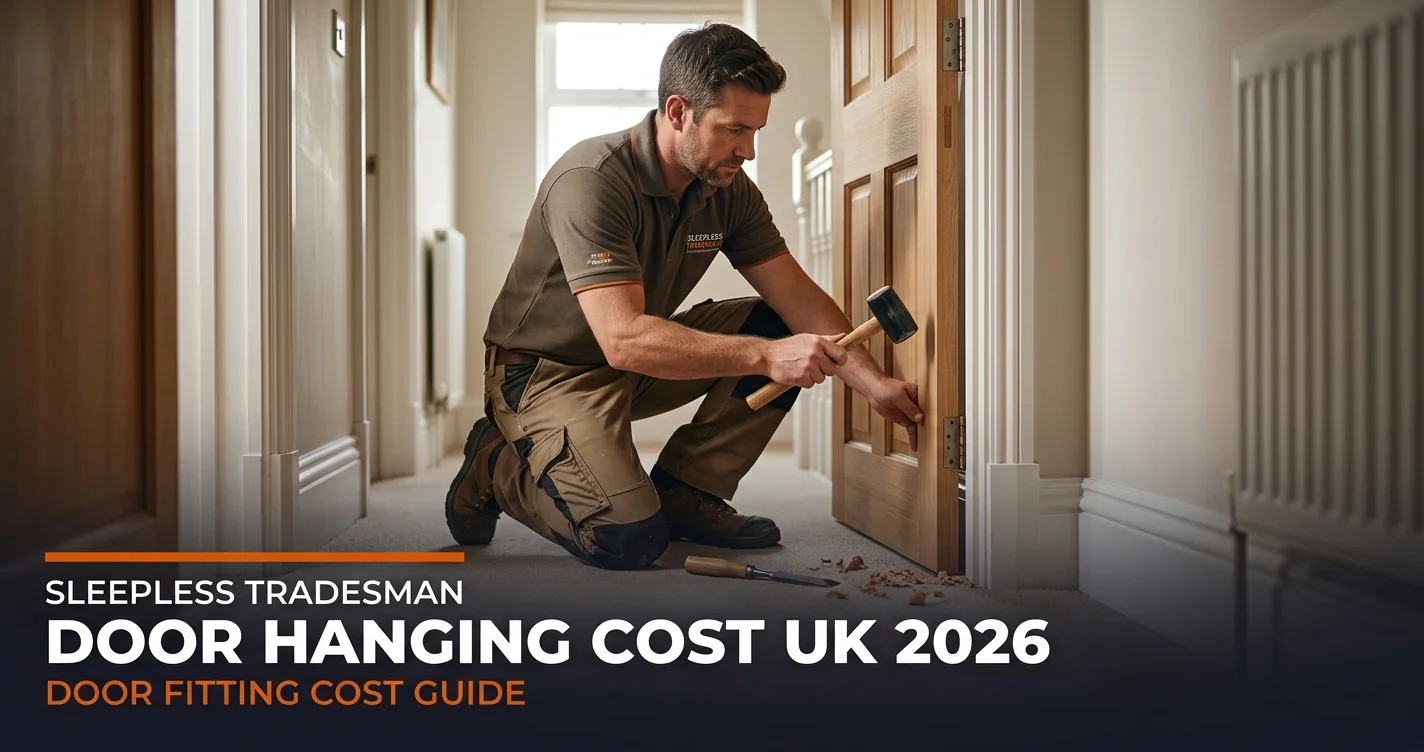
Door Hanging Cost per Door UK 2026
The table below shows typical supply and fit prices for hanging doors in the UK, including joiner labour and ironmongery. Prices exclude the door itself unless stated as supply and fit.
| Door type | Labour only | Supply & fit | Notes |
|---|---|---|---|
| Internal hollow-core door | £80 – £150 | £150 – £300 | New frame, hinges, handle included |
| Internal solid-core door | £100 – £180 | £200 – £400 | Heavier — more fitting time |
| Exterior front door (UPVC) | £150 – £250 | £600 – £1,500 | Frame, locks, weatherstrip included |
| Exterior front door (composite) | £200 – £350 | £900 – £2,500 | Premium security locks standard |
| Fire door (FD30) | £120 – £220 | £280 – £500 | Intumescent strips, self-closer required |
| Bi-fold internal doors (per set) | £200 – £400 | £500 – £1,200 | Track system and alignment critical |
| Pocket/sliding door | £250 – £450 | £600 – £1,400 | Frame/lintel work often required |
Labour-only prices assume an existing frame is reused. Supply and fit prices include a mid-range door, frame, ironmongery, and installation. London and South East prices are typically 20–30% higher.
Internal Door Hanging Costs UK 2026
Internal door hanging is one of the most common jobs a joiner carries out, and the pricing varies considerably depending on whether you are supplying the door yourself or having the joiner source it, the type of door, and the condition of the existing frame and opening.
For labour only, where you supply the door, the frame, and all ironmongery, a standard internal door in a good-condition opening costs £80-130 in most parts of England and Wales. In London, that rises to £110-180 to reflect higher joiner day rates in the capital. This covers the joiner measuring and planing the door to fit, setting the hinges, hanging the door, and fitting the latch and handles. It does not include making good any plasterwork around the frame or painting.
If you want the joiner to supply and fit everything, costs rise significantly because you are also paying for the door, frame, architrave sets, hinges, and ironmongery. A hollow-core internal door with a new softwood frame, architrave, and a basic lever handle set typically costs £200-320 supply and fit. A solid core door, which is heavier and requires more careful hinge setting, costs £280-450 supply and fit. Solid core doors are worth the additional cost in areas where sound insulation matters, such as home offices, bedrooms next to living spaces, or anywhere noise bleed between rooms is a concern.
Where a door is being fitted into an existing frame rather than a new frame, costs drop to £60-100 in labour, as the joiner is only trimming and hanging the door rather than fitting a full lining set. This is common in renovations where the existing frames are in good condition and only the door leaf itself needs replacing.
Out-of-square openings are a common issue in older UK properties, particularly Victorian and Edwardian terraces where walls have settled over time. A joiner encountering a significantly racked frame may charge an additional £30-60 to plane and fit the door correctly. It is worth discussing this upfront if you know the property is old, rather than discovering it as an add-on mid-job.
For a full house fit-out with multiple internal doors, such as a new build completion or a renovation with five or more doors, joiners will typically offer a reduced per-door rate. Ten to twenty percent off the single-door rate is common for six or more doors, as the joiner can work efficiently through the property without the stop-start of individual visits. If you are quoting multi-door work and want to check your day rate is set correctly before pricing, the hourly rate calculator is a useful starting point.
External Door Costs UK 2026
External doors require considerably more time and skill than internal doors. They are heavier, must be fully weatherproof, and in most cases have multi-point locking systems rather than a simple latch. The frame must be perfectly plumb and level, as any twist will cause the door to bind and will compromise the weather seal over time.
For labour only, where you supply the door and frame, expect to pay £150-250 per door. This accounts for the greater time involved in hanging a heavy external door, setting the multi-point lock mechanism, and fitting draught seals and weather bars correctly. In London, add 25-35% to these figures.
On a supply-and-fit basis, the door type drives the price significantly. Composite external doors are the most popular choice in the UK in 2026, combining a foam-insulated core with a GRP (glass-reinforced plastic) outer skin that does not warp, rot, or require painting. A standard composite front door, including a multi-point lock, letterbox, and basic furniture, costs £900-1,800 supply and fit depending on the style, glazing configuration, and hardware specification.
Hardwood external doors are typically chosen for period properties where a composite or uPVC door would look out of place. Oak or hardwood external doors with traditional ironmongery cost £1,200-2,500 supply and fit. The range is wide because bespoke dimensions, glazing panels, and decorative mouldings all add to the joinery cost, and a Georgian or Victorian front door in a conservation area may need to be made to measure rather than taken from a standard range.
uPVC external doors are the budget option at £700-1,400 supply and fit. They are energy efficient and low maintenance, but they do not suit all properties aesthetically and are not appropriate for listed buildings or conservation areas without planning consent.
French doors, which cover a double opening typically between 1,600mm and 2,400mm wide, cost £2,000-4,000 supply and fit in timber or aluminium. The wider the opening, the more the frame needs to be checked for structural support above, as removing a section of external wall requires an appropriate lintel that may need a structural engineer to specify.
Note that replacing an external door in a flat with shared corridors or in a commercial building may require notification under building regulations, particularly where fire-rating of the separation is a requirement. Your joiner or contractor should advise on this before work begins. For guidance on what to include in a joinery quote and how to price this type of work, see the guide to pricing joinery work in the UK.
Homeowners updating external doors often consider window replacement at the same time, particularly where uPVC or composite units are being matched across the front elevation. Our guide to window fitter and glazier day rates covers what this specialist work costs in 2026 and the key differences between uPVC, aluminium, and timber glazing contractors.
Fire Door Costs and Requirements
Fire doors are a legal requirement in specific parts of a domestic property under the Building Regulations. In England and Wales, all doors off the hallway or stairwell in a house of three or more storeys must be FD30 fire doors (30 minutes fire resistance), as must the door between an integral garage and the main house. In HMOs (houses in multiple occupation), fire doors are required throughout, and the specific requirement is set by the local authority fire risk assessment. All new builds also require fire doors in specific locations as standard.
Hanging a fire door costs more than hanging a standard internal door for two reasons. First, the door itself costs more: a certificated FD30 fire door blank costs £80-200 before frame and hardware, versus £30-80 for a standard hollow-core door. Second, the fitting requires greater precision. Fire door gap tolerances are tight: typically a maximum of 3mm at the head and jambs, and up to 8mm at the floor. These gaps must be consistent around the full perimeter for the door to perform correctly in a fire situation.
Intumescent strips (which expand under heat to seal the gap around the door) and cold smoke seals must be fitted in the frame rebate or the door edge. Self-closing mechanisms, either overhead door closers or concealed floor or overhead spring mechanisms, are mandatory. The hinges must be fire-rated: a minimum of three hinges certified for fire door use. A fire door hung with standard hinges or without intumescent strips is non-compliant regardless of the door specification.
Labour to hang a fire door costs £130-200 per door, versus £80-130 for a standard internal door. The additional cost reflects the extra care required to achieve correct gaps and the time spent fitting seals and closers. Supply and fit for an FD30 fire door with a new frame, intumescent strips, smoke seals, three fire-rated hinges, and an overhead closer costs £350-600. For FD60 doors, which are required in higher-risk areas such as plant rooms and certain commercial applications, supply and fit costs £500-900.
If you have existing doors that need to be upgraded to fire doors rather than fully replaced, intumescent strips can be retro-fitted into the existing frame rebate at £40-80 per door including labour. However, this is only appropriate where the door itself is a certificated fire door: you cannot turn a standard hollow-core door into a fire door by adding strips alone. If there is any doubt about whether the existing door leaf has the required certification, it is safer and more cost-effective to replace it in full.
Bi-fold, Pocket and Sliding Door Costs
Bi-fold and pocket doors have become a popular choice in open-plan renovations across the UK, particularly in kitchen extensions and through-lounges where a standard swing door would consume valuable floor space or interrupt the flow of a room. They are not more expensive to supply than a standard door in all cases, but the fitting is more complex and the hardware quality matters considerably to the long-term performance of the installation.
A pair of internal bi-fold doors, covering a 900mm to 1,000mm opening in MDF or hollow-core, costs £300-600 supply and fit. This covers a two-panel set on a top-hung track system, which is the most common configuration for standard doorway widths. For a larger four-panel set covering a 1,800mm to 2,000mm opening, such as between a kitchen and a dining room, expect to pay £600-1,200 supply and fit.
The track system and pivot hardware are the critical components in a bi-fold installation. Cheap track systems will deflect under the weight of the panels over time, causing the doors to drag or fail to align correctly when folded. Spend on quality hardware from a reputable manufacturer and you are likely to get a decade or more of trouble-free use. The fitting itself requires the track to be perfectly level in the head of the opening, and the bottom guide pivot to be set precisely, so the doors fold without racking.
Pocket doors, where the door slides into a cavity within the wall itself, are popular for utility rooms, home offices, and en-suites where space is tight. The pocket door kit, which forms the internal wall structure that the door slides into, must be installed before the wall is plastered. Retro-fitting a pocket door into an existing plastered wall is a significant structural job. For a standard single pocket door installed in a new partition or during a renovation with the wall open, supply and fit costs £400-800 including the kit, door, and hardware.
Sliding barn doors, mounted on an exposed track on the surface of the wall rather than concealing into it, have grown in popularity for utility rooms, home offices, and more industrial-style interiors. A standard sliding barn door on a black steel track costs £300-700 supply and fit, depending on the door material and track length.
All of these door types require a joiner with specific experience fitting them, as the fitting tolerances and hardware adjustment sequences differ from a standard swing door. If you are a self-employed joiner quoting this type of work for the first time, it is worth reviewing your day rate for this kind of job against the carpenter and joiner day rate guide for 2026 to ensure you are charging appropriately for the skill level involved.
What to Expect When Getting a Door Hanging Quote
A professional joiner should measure the opening on site before providing a written quote, not estimate from your verbal description over the phone. The height and width of the opening, the reveal depth, the condition of the existing frame, and whether the opening is plumb and square all affect the quote and the time required. If a joiner is quoting door hanging without visiting, be cautious: the on-site reality rarely matches the phone description, and a quote based on assumptions will often change once work is underway.
When comparing quotes from different joiners, check carefully what each one includes. The most common variable is ironmongery: some joiners price to include a basic lever handle set and hinges, while others expect you to supply your own. Similarly, the door frame and architrave are sometimes included and sometimes treated as a separate line. A quote that appears lower at first glance may simply have excluded more from its scope. Ask each joiner to provide an itemised breakdown of what is and is not included so you are comparing like with like.
Making good the plasterwork around a new frame is almost always excluded from a door hanging quote and should be priced separately by a plasterer. When a new frame is fitted to a masonry opening, the reveal will typically need patching with plaster before it is ready to paint. Budget £50-120 per door for a plasterer to make good the reveal and architrave line.
For a multi-door project covering a full renovation or new-build fit-out, negotiate a total job price rather than a per-door rate. Joiners working on three or more doors at once can batch their work efficiently, cutting all doors to size at once, setting out hinge positions on multiple doors before chiselling any, and working through the property systematically. This efficiency should translate into a lower per-door cost, and it is reasonable to ask for it explicitly when inviting quotes for larger jobs. A reduction of 10-20% per door on the single-door rate is normal for six or more doors.
If you are a joiner looking to price door hanging work more systematically, the material markup calculator helps you work out the right margin on door and hardware supply, and the hourly rate calculator ensures your labour rate covers your costs and target income before you build any quote on top of it.
Payment terms for door hanging work are typically straightforward. For single-door jobs, most joiners will invoice on completion. For multi-door projects as part of a larger fit-out, a deposit of 25-30% at the start of the job with the balance on completion is standard. Avoid paying in full before work begins, and get any written quote signed off by both parties before work starts on larger jobs to avoid disputes over scope later.
Frequently Asked Questions
How much does it cost to hang an internal door in the UK?
Labour to hang a standard internal door costs £80-130 in 2026 if the customer supplies the door, frame, and ironmongery. In London, that rises to £110-180 to reflect higher joiner rates in the capital. For a full supply-and-hang including a hollow-core door, frame, architrave sets, three hinges, and a lever latch set, expect to pay £200-350. Solid core internal doors cost £280-450 supply and fit because they are heavier to handle and require more precise hinge setting to prevent the door from dropping over time. The joiner should trim the door to fit the opening, hang it on three hinges for a standard-width door, and fit and adjust the latch and handles before signing off the job.
How long does it take to hang a door?
An experienced joiner can hang a standard internal door into an existing frame in 1.5 to 2.5 hours. This includes measuring, planing the door to fit, marking and chiselling the hinge recesses, hanging the door, and fitting and adjusting the latch and handles. Fitting a new frame from scratch adds roughly another hour. External doors take longer: 3-5 hours is typical because the door is heavier, the multi-point lock mechanism needs careful alignment, and the weather seal and threshold bar must be fitted correctly. Bi-fold and pocket door installations take 2-4 hours per set depending on the number of panels. In older properties, out-of-square openings can add significant time as the joiner may need to plane the door on multiple edges and pack out the frame before it sits level and plumb.
Does a fire door cost more to hang?
Yes, fire doors cost noticeably more to hang than standard internal doors. The fitting requires tighter tolerances, with a maximum gap of 3mm at the head and jambs and up to 8mm at the floor, and the joiner must fit intumescent strips and cold smoke seals in the frame rebate as part of the job. A self-closing mechanism is also mandatory. Labour to hang a fire door runs £130-200 versus £80-130 for a standard internal door. Supply and fit for an FD30 fire door with a new frame, all required hardware, and an overhead closer costs £350-600. The door must be certificated to the correct standard: a standard hollow-core door cannot be upgraded to fire door status by fitting strips alone, so if you are in any doubt about what you currently have, get the joiner to check the door leaf certification before deciding whether to upgrade or replace.
What is included in a standard door hanging quote?
A standard door hanging quote should cover: measuring and trimming the door to fit the opening accurately, hanging the door on three hinges, fitting the latch or lock and handles, adjusting the door for smooth operation without binding, and a check of the frame for level and plumb. It will not typically include: making good plasterwork around the frame, painting or decorating the door or frame, or supplying the door, frame, or ironmongery unless these are separately specified and priced in the quote. Always ask for a written breakdown so you know exactly what you are paying for, and clarify the ironmongery and frame position before accepting the quote to avoid unexpected additions to the final bill.
Can any tradesman hang a door, or does it need to be a joiner?
Door hanging does not require a licence, but it is a skilled carpentry job that is harder than it looks. A badly hung door will drop within a year, bind on the frame, fail to latch correctly, or swing open under its own weight. A skilled joiner will identify and correct out-of-square openings, plane the door accurately on the correct edges, and set the hinges so the door hangs plumb and swings freely without springing open. For fire doors specifically, the work must be carried out by a competent person with a clear understanding of fire compartmentation requirements. An incorrectly fitted fire door, whether due to excessive gaps, missing seals, or incorrect hardware, will fail a fire inspection and leave the property owner liable. It is not a job to hand to the cheapest available option on a fire door.
How much does it cost to hang bi-fold doors internally?
A standard pair of internal bi-fold doors in MDF or hollow-core, covering a 900mm to 1,000mm opening, costs £300-600 supply and fit in 2026. A four-panel set covering a 1,800mm to 2,000mm opening, which is a common choice for room dividers in open-plan kitchens and living areas, costs £600-1,200 supply and fit. Solid timber or glazed bi-fold panels push the cost higher still, as the panels are heavier and require a more robust track system. The quality of the track and pivot hardware is the most important variable: cheap systems deflect over time and cause the doors to drag or mis-align. Budget appropriately for hardware from a reputable supplier, as replacing a failed track system after the decoration is done is a frustrating and expensive job.
Are you a joiner pricing door hanging work?
Sleepless Tradesman has tools built for self-employed joiners and carpenters. Use the hourly rate calculator to check your charge-out rate, the material markup calculator to price your door and hardware supply correctly, and the quoting tool to send professional quotes to clients directly from your phone.
Related Guides and Tools
How to Price Joinery Work in the UK
Quoting and pricing guide for self-employed joiners
Carpenter and Joiner Day Rate UK 2026
What carpenters charge per day by region and trade type
Bathroom Renovation Cost UK 2026
Full cost breakdown for a UK bathroom refit
Hourly Rate Calculator
Work out the right charge-out rate for your trade business
Material Markup Calculator
Price materials correctly with the right margin