Turning Your Van Into A Mobile Command Center With Real Time AI Analytics
Your van is your office. Most tradespeople treat it like a storage unit on wheels. Here's how to set it up as a fully functional mobile command centre — with AI tools that give you real-time visibility over your business.
Written by Tom Ellis · Senior Trades Editor
Last updated: 25 May 2026
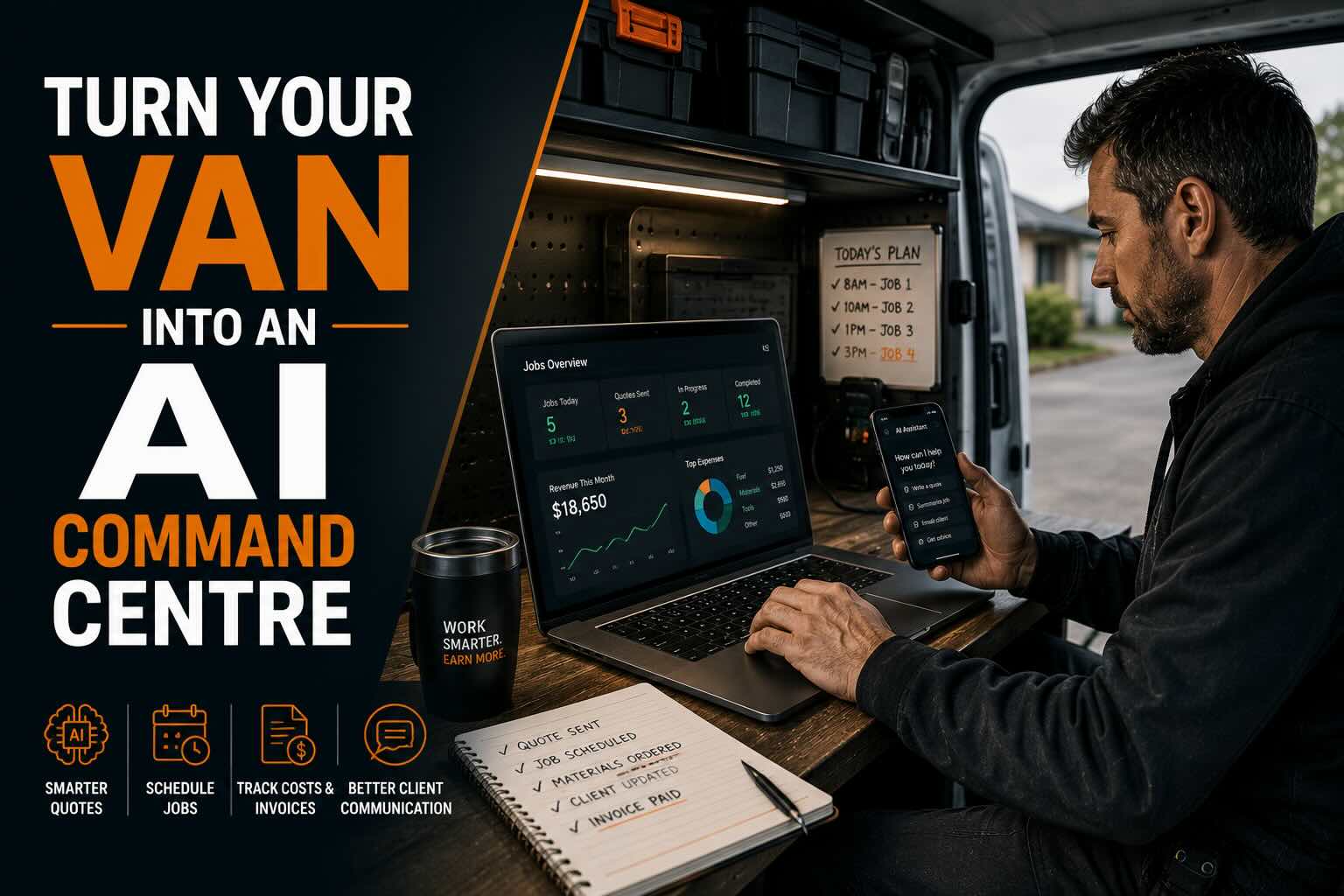
Most tradespeople spend between 30 and 90 minutes a day inside their van. That's 150 to 450 hours a year. If you're using that time purely as a driving-and-eating vessel, you're leaving a significant productivity asset idle.
The tradespeople who run tight, profitable businesses don't have an office they go back to. They've made the van the office — and they use technology to make it actually work.
This guide covers the practical setup: hardware, connectivity, software, and specifically how AI analytics tools are changing what's possible for one-man-bands and small trade teams in 2025.
Why Your Van Is Already a Better Office Than You Think
A Transit or Sprinter has roughly 2–3 cubic metres of loadable space, a 12V electrical system, a reasonably quiet and private environment, and mobile connectivity. That's not nothing.
The issue isn't the van — it's that most tradespeople haven't deliberately designed the mobile workspace. They've accumulated a pile of paperwork in the passenger footwell, a phone charger that keeps falling out, and a laptop they only open at home.
A deliberate setup changes everything.
The Hardware Layer: What You Actually Need
A Proper 12V Power System
Running electronics from your starter battery while the engine is off will leave you stranded within a couple of hours. The fix is a leisure battery — a secondary deep-cycle battery that can be discharged and recharged repeatedly without affecting the starter battery.
A 100Ah leisure battery costs £80–£150 and connects to your van's electrical system via a voltage-sensitive relay (VSR) that charges it when the engine runs and isolates it when the engine stops. This setup gives you:
- 5–8 hours of laptop and phone charging
- Enough power to run an inverter for a charger, a small desk lamp, and a tablet simultaneously
- The ability to run a 12V compressor fridge if your work includes catering or you're on longer remote jobs
For heavier power users: A 200Ah lithium (LiFePO4) leisure battery provides double the usable capacity at roughly double the cost (£250–£400) and lasts 10x longer than lead-acid. If you're running power tools from the van or doing a lot of overnight stops, it's worth the investment.
A Quality Inverter
A 600W to 1000W pure sine wave inverter lets you run laptop chargers, monitor chargers, and any standard mains-powered device from your leisure battery. Avoid modified sine wave inverters — they cause interference with electronics and can damage sensitive chargers.
Mounting it close to the leisure battery (short cable runs = less voltage drop) with an inline fuse is the right approach. Most tradespeople mount it under the passenger seat or in a dedicated cabinet behind the cab.
Connectivity: Mobile Wi-Fi Is Non-Negotiable
Working from your phone's hotspot works, but it kills your phone battery, ties up your data plan, and disconnects when you get a call. A dedicated mobile Wi-Fi router with its own SIM is worth every penny.
Options:
- TP-Link M7350 (4G): £50–£60, takes a standard SIM, creates a private Wi-Fi network for all your devices
- Teltonika RUT241: More expensive (£120–£150) but significantly more reliable in low-signal areas — worth it if you regularly work in rural areas or basements
For the SIM itself: get a data-only SIM with a 50–100GB monthly plan. SMARTY, VOXI, or GiffGaff offer plans at £10–£20/month on Three's network, which has strong rural UK coverage.
A Tablet or Secondary Screen
Working from a phone is fine for quick tasks, but reviewing a multi-page job quote, checking a technical drawing, or monitoring a project dashboard is painful on a 6-inch screen.
A basic 10-inch Android tablet (Samsung Tab A8 or similar, £150–£200) mounted on an adjustable arm behind the driver's seat gives you a proper working screen. You can run job management software, AI quoting tools, and email simultaneously while your phone stays free for calls.
Van-specific mounting: Use a headrest mount or a suction/arm mount rated for vehicles. Avoid budget mounts — a tablet flying across the cab at 60mph on the A14 is a serious hazard.
The Software Layer: What AI Tools Actually Do For You
Hardware gets you connected. The software layer is where the real productivity gains come from.
Real-Time Job Costing and Quoting
The most time-consuming admin task for most tradespeople isn't invoicing — it's quoting. Working out materials, labour time, margins, VAT, and producing something professional that you're not embarrassed to hand over takes 30–90 minutes per quote if you're doing it from scratch each time.
AI-powered quoting tools change this fundamentally. Tools like Sleepless Tradesman use AI to generate detailed, professional quotes from a brief description of the job. You describe the work, add the specifics, and the AI produces a structured quote with line items, labour estimates, and materials — which you can edit, approve, and send directly from your van within minutes of the site visit.
The analytics dimension comes from the AI tracking patterns across your quotes over time:
- Which job types are most profitable for you?
- Where are you consistently under-quoting?
- What's your win rate on different quote values?
This isn't abstract data science — it's directly actionable intelligence. If the AI shows you that your boiler installation quotes have a 70% win rate but your bathroom renovation quotes have a 20% win rate, that tells you something about your pricing, your market positioning, or both.
Invoice-to-Payment Tracking
Cash flow is the killer of small trade businesses. Not lack of work — cash flow. You've done the job, raised the invoice, and now you're waiting 14–45 days for payment while your materials supplier wants to be paid in 30 days.
Mobile-first invoicing tools with payment tracking give you a live view of what's outstanding, what's overdue, and what's coming in — accessible from the van dashboard. Instead of discovering at month end that three invoices haven't been paid, you see it in real time and can chase promptly.
Automatic payment reminders (sent on day 7, day 14, and day 30 of non-payment) alone typically reduce average payment times by 40–60% for tradespeople who implement them. That's not a marginal improvement — it's the difference between managing your overdraft and not needing one.
Scheduling and Route Optimisation
If you have more than two jobs per day, scheduling them in a suboptimal order costs you time and fuel. AI scheduling tools (integrated into job management platforms) suggest the optimal order for jobs based on location, minimising drive time.
For a tradesperson doing 4–6 jobs per day across a city, this can save 20–40 minutes of drive time daily. Over a working year, that's 70–140 hours — almost a full month of work days.
Supplier Price Checking On Site
Standing in a client's kitchen being asked 'so how much for new kitchen tap and fitting?' and having to say 'I'll come back to you' is a lost opportunity. With a connected tablet and real-time access to Travis Perkins, Screwfix, and Wolseley trade pricing, you can check material costs on the spot and turn a ballpark number into a confident quote within 10 minutes.
Organising the Physical Space
The physical organisation of the van directly affects how efficiently you can work from it. A van where you have to move three tool bags to access your tablet mount is a van you'll avoid working from.
The core principle: Separate the work area from the storage area. In a standard panel van:
- Rear 2/3 of load space: Racking, shelving, and secure storage for tools and materials
- Passenger seat area: Your working position — tablet mount, phone holder, charger port, notepad holder
- Behind the cab bulkhead (where available): Leisure battery, inverter, and any fixed electronics
Racking systems from Van Vault, Sortimo, or Bott cost £600–£2,000 fitted but pay back in time saved (not searching for tools) and reduced breakage (tools properly stored survive longer). Many tradespeople report finding £200–£400 of previously-lost small tools and equipment when they fit proper racking.
Security: Protecting Your Mobile Office
A van containing a leisure battery setup, quality tablet, and business data is a theft target. The UK sees approximately 26,000 commercial vehicle break-ins per year.
Physical security:
- Deadlocks on the rear and side doors (Armaplate or equivalent) — £150–£300 fitted
- Van alarm with GPS tracking — Thatcham Category 1 alarm plus a Tracker or Meta Trak unit, £300–£600 fitted
- Keep no visible electronics when parked — the tablet should live in a locked cab drawer or glove box
Data security: This matters more than most tradespeople realise. Your phone and tablet contain client contact details, addresses, job histories, and payment information. If they're stolen unprotected, that's a potential GDPR data breach with real consequences.
- Use screen lock with PIN or biometric on all devices
- Enable remote wipe on phones and tablets (Find My Device / Find My iPhone)
- Use a business password manager (Bitwarden is free) rather than writing passwords on notepad in the cab
The Connected Tradesperson: Realistic Expectations
Setting this up properly takes half a day and costs between £300 and £800 depending on how much of the hardware you already have. The productivity return — measured in hours saved on admin, quotes sent faster, invoices paid sooner, and miles not wasted — typically shows up within the first month.
The tradespeople who resist it usually do so because 'I'm not tech-savvy.' But if you can use a smartphone for banking, you can use a mobile job management platform. The AI does the complex work. You just describe jobs and approve outputs.
Platforms like Sleepless Tradesman are specifically built for tradespeople who didn't go to business school — the interface is built around how trade work actually happens, not how an accountant thinks it should be tracked.
FAQ
How much does it cost to set up a van as a mobile office from scratch?
A basic functional setup (leisure battery, VSR, inverter, mobile Wi-Fi router, phone mount) costs £200–£400 in parts plus a few hours of installation time. A comprehensive setup with tablet, quality racking, and a proper inverter system costs £500–£900. This is a capital expense and 100% tax-deductible as business equipment.
What's the best SIM for van Wi-Fi in rural UK areas?
Three has the strongest rural UK coverage for data and works well in most of England and Wales outside of very remote areas. For consistently patchy signal areas (Scottish Highlands, rural Wales, parts of Cornwall), EE has better rural coverage but costs more. Consider a router that supports dual SIM (like the Teltonika RUT241) so you can switch networks automatically.
Will I use a mobile data plan for AI quoting tools?
AI quoting and job management tools like Sleepless Tradesman are not data-heavy by smartphone standards. A typical session — generating a quote, reviewing it, sending it — uses 1–5MB of data. A 20GB monthly plan is comfortably sufficient for a full working month of active use. Most tools also have some offline capability so you can work in areas with no signal and sync when connectivity resumes.
Is it worth fitting a dashcam as part of the van setup?
Absolutely. A front and rear dashcam (£60–£150 for a quality unit like Viofo or Nextbase) is one of the highest-return investments you can make. Insurance premiums for tradespeople with dashcam footage discounts can save £50–£200 per year, and in the event of an accident that isn't your fault, having footage means a clear liability outcome rather than a contested claim that affects your no-claims record. Wire it to the leisure battery for parking mode, so it records even when the van is parked.
Ready to work smarter?
Join thousands of tradespeople using AI to save time on quotes, invoices, and job planning.
Try Sleepless Tradesman FreeRelated Guides
Free resources from our UK tradesperson guide library