Why AI Customer Support Is The Only Way To Stop Ghosting Clients Forever
A client asks for a quote, you send it, and then — silence. This is the single biggest frustration for self-employed tradespeople. AI-powered communication tools are the only scalable solution.
Written by Tom Ellis · Senior Trades Editor
Last updated: 25 May 2026
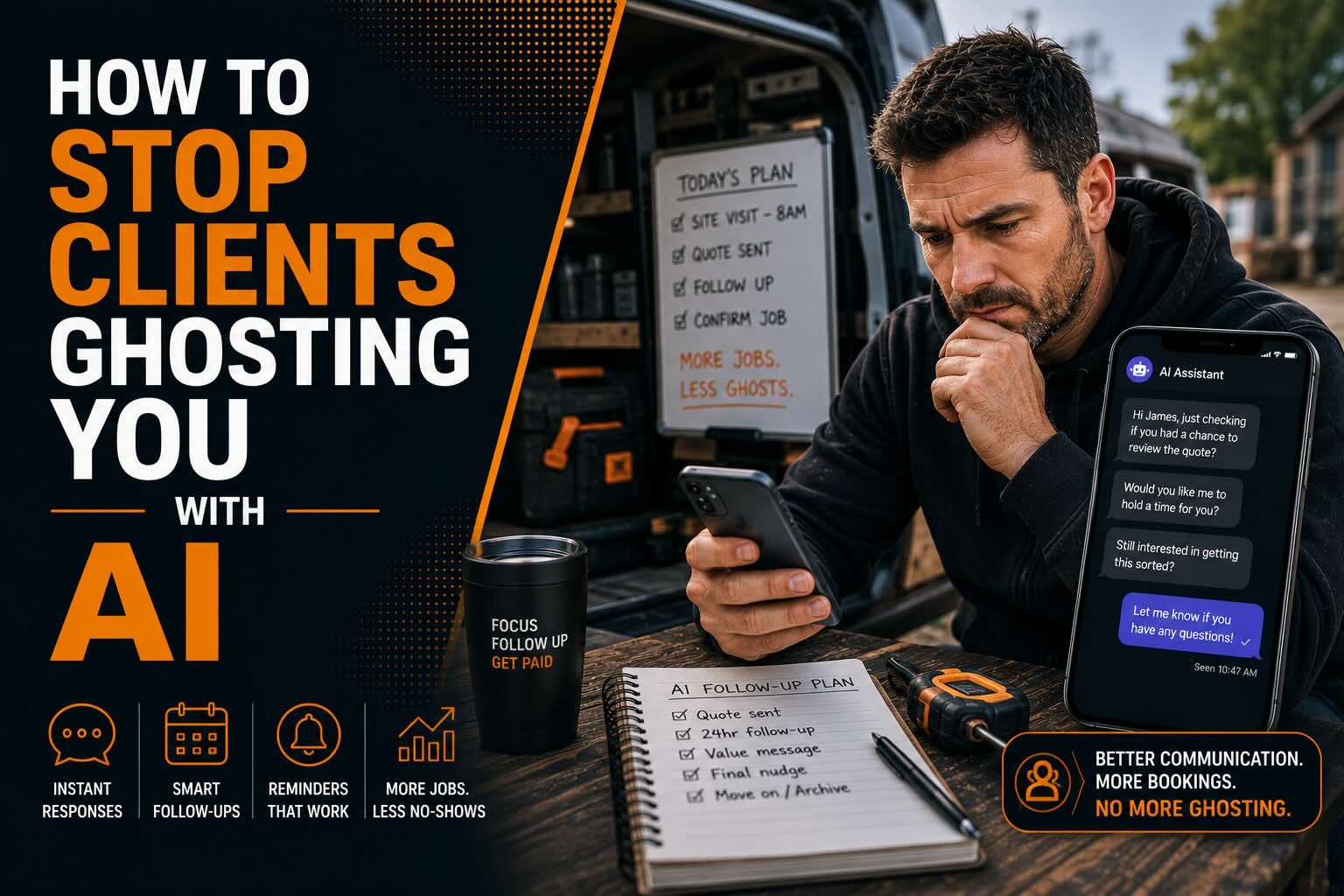
You've been there. You drive 40 minutes to site, spend an hour assessing the job, go home and spend another hour building a proper quote, send it across, and then hear absolutely nothing. No response to your follow-up call. No reply to your text. The client has vanished.
Client ghosting is the silent revenue killer for self-employed tradespeople. You can't invoice a job you didn't win. You can't plan your diary around work that might or might not happen. And the time spent quoting jobs that evaporate is time you're not spending on paying work.
This isn't a personality problem. It's a systems problem. And AI is the most powerful fix available.
Why Clients Ghost — The Real Reasons
Before we talk about solutions, let's be honest about why it happens. Understanding the cause determines the right fix.
1. They Got Three Quotes and Went with the First Reply
Most homeowners and small business clients contact 2–4 tradespeople. They go with whoever follows up fastest. Research in professional services consistently shows that the first supplier to follow up — not the cheapest, not the most experienced — wins the majority of jobs.
If you're sending a quote and waiting 48 hours for them to come back to you, you've already lost to the plumber who called them back within 20 minutes of their enquiry.
2. Your Quote Was Confusing or Scary
A quote that just says 'Labour and materials: £1,850' with no breakdown creates anxiety in the client. They don't know what they're paying for. They don't know if it includes the part they specifically mentioned. They're not sure if it includes VAT. They'd rather avoid the awkward conversation of asking you to explain it, so they just don't reply.
A detailed, itemised quote that explains exactly what's included, what's excluded, how long the job will take, and what happens if unforeseen issues arise is dramatically more likely to get a response — even if the answer is no.
3. They've Moved On With Life
A homeowner who contacts a tradesperson is often in a reactive mindset — something's broken, they need it fixed. But if you take more than a few days to turn a quote around, life has moved on. The leak got slightly better. The kitchen renovation isn't as urgent. The bathroom feels fine for now. Your quote lands in their inbox when the urgency has passed.
4. Your Follow-Up Is Too Pushy or Non-Existent
Most tradespeople do one of two things: send the quote and wait indefinitely, or call twice and then give up. Both approaches have low conversion rates.
Effective follow-up is a sequence — timed, non-pushy, genuinely helpful — that keeps you top of mind without making the client feel harassed.
How AI Changes the Equation
Speed of Response: Automated Initial Replies
The biggest single improvement you can make to your quote win rate is responding to enquiries faster. AI tools allow you to set up automated initial responses that acknowledge the enquiry, confirm the details you need to quote, and give the client a realistic timeframe — all within minutes of their message arriving, even when you're mid-job.
This isn't about replacing your personal response. It's about filling the gap between 'client sends enquiry' and 'you can actually stop and respond'. That gap — which might be 2–4 hours on a busy day — is where you lose jobs to faster-responding competitors.
A well-crafted auto-response that says 'Thanks for getting in touch — I've received your message about [type of job] and will be in touch by [specific time] with an availability and pricing overview. In the meantime, here are three things that help me quote more accurately…' converts dramatically better than silence.
Quote Quality: AI-Generated Detailed Proposals
Platforms like Sleepless Tradesman use AI to generate professional, detailed quotes from your job notes. Instead of a hand-typed email with a single line price, you produce a structured document with:
- Scope of work broken down by phase
- Materials listed with specifications
- Labour hours and rates
- Clear inclusions and exclusions
- Payment terms and schedule
- Your qualifications and insurances
The psychological impact of receiving this kind of professional document versus a brief email is significant. It signals competence, seriousness, and value — all of which reduce the likelihood of the client simply ignoring it because it feels too informal to engage with.
More importantly, a detailed quote that directly addresses the client's stated requirements and concerns leaves no ambiguity that might cause hesitation. If the client mentioned 'I'm worried about disruption to the kitchen', your AI-generated quote explicitly covers the working approach and how disruption will be managed. That specificity converts.
Automated Follow-Up Sequences
This is where AI genuinely solves the ghosting problem structurally. Instead of you remembering to follow up (and feeling awkward doing it), an automated sequence handles it:
Day 1 after quote: Quote sent with a personal covering message Day 3: Automated follow-up: 'Just checking you received my quote for [job type] — happy to run through any questions by phone if that's easier' Day 7: Automated follow-up: 'My availability for this job is [specific dates] — I wanted to let you know in case you're planning around timing' Day 14: Final follow-up: 'I'll assume you're going ahead with alternative arrangements, but do feel free to get back in touch if anything changes'
This sequence works because it's helpful rather than pushy. Each message provides value (answers to questions, timing information, no-obligation close) rather than just asking 'have you decided yet?'
Tradespeople who implement structured follow-up sequences typically see quote conversion rates improve by 15–35%. For a tradesperson sending 30 quotes per month, moving from a 30% win rate to a 40% win rate represents three additional jobs per month — potentially £1,500–£3,000 in additional revenue.
Reading the Data: AI Analytics on Quote Performance
Over time, an AI-powered platform like Sleepless Tradesman builds a dataset from your quoting history that tells you things you'd never work out manually:
- Response rate by quote value: Do smaller jobs get faster responses? This might indicate your pricing on larger jobs needs work — either too high, or the breakdown isn't clear enough.
- Win rate by client type: Homeowners vs landlords vs commercial clients vs builders — which type are you winning most efficiently?
- Win rate by quote turnaround time: Is there a clear pattern showing faster quotes win more? (Almost always yes.)
- Win rate by follow-up frequency: Does the three-touch sequence outperform the one-touch? Where do clients tend to respond in the sequence?
None of this requires you to be a data analyst. The AI surfaces the relevant patterns and presents them as actionable insights. The question 'why do I keep losing bathroom jobs?' gets answered with real data rather than guesswork.
The Human Element: What AI Cannot Replace
AI handles speed, consistency, and data. But three things still need you:
1. The Site Visit
For any job over £500, a site visit before quoting is almost always worth it. Clients who meet you in person before receiving a quote ghost at a fraction of the rate of clients who only interact with you digitally. You've become a real person to them.
The AI can prepare you for the site visit (customer history, similar job notes, key questions to ask) and follow up after it. But it can't shake a client's hand.
2. Handling Specific Concerns
When a client does respond with a concern — 'your price is higher than another quote I received', or 'I'm not sure about the timeline' — that's a conversation that needs genuine engagement. AI can draft a response for you to personalise, but the final message should sound like you, not like a template.
3. Relationship Building
Your repeat clients — the ones who call you every time they need work done and who refer their neighbours and colleagues to you — are built on relationship, not systems. The AI handles the transactional side. Your job is to be genuinely good at the work and genuinely decent to deal with. Those clients don't ghost. They call you directly.
Practical Implementation: Where to Start
If you're currently doing all of this manually (or not at all), don't try to implement everything at once.
Week 1: Set up an automated acknowledgement response for new enquiries. Even a simple SMS autoresponder that fires when you receive a text does more than nothing.
Week 2–3: Switch to a proper quoting tool. If you're not already using Sleepless Tradesman or similar, the difference in quote professionalism — and the time saved per quote — will be immediately apparent.
Week 4 onwards: Implement a structured follow-up sequence. Start simple (two follow-ups at 3 and 7 days) and add to it as you see what works.
Month 2 onwards: Start paying attention to the analytics. Which jobs are you winning? Which are you losing? Let the data guide where you focus your improvement.
What Good Looks Like: A Real Example
A self-employed plumber in Manchester switched to AI-assisted quoting and follow-up after consistently losing what he estimated was 20–30% of quotes to non-responses. Here's what changed:
- Quote turnaround time dropped from 24–48 hours to under 2 hours (AI generated first draft, he reviewed and personalised)
- Quote response rate (any response, yes or no) increased from 55% to 80%
- Win rate on responded quotes increased from 45% to 55% (better quote quality and faster follow-up)
- Overall job win rate from enquiry to contract: up from approximately 25% to 44%
At an average job value of £650, that improvement represents roughly an additional £2,500–£3,000 in monthly revenue from the same marketing spend and lead volume.
FAQ
How do I follow up without sounding desperate or pushy?
The key is providing value in each follow-up rather than just chasing a decision. Instead of 'have you had a chance to look at my quote?', say 'I wanted to flag that I have availability [specific date] for this job — if timing is a factor in your decision, I'm happy to hold that slot for a few days.' You're giving them useful information, not asking them to do something for you.
What if a client explicitly says they're going with someone else?
Thank them genuinely, wish them well, and ask if they'd mind briefly sharing why — whether it was price, timing, or something else. This isn't to challenge their decision; it's free market research. Most people will give you an honest answer if asked nicely. Over time, patterns in these answers will tell you exactly where to improve.
Should I use WhatsApp for business communication?
Many tradespeople find WhatsApp effective for client communication because clients respond faster and more casually than to email. If you use it, keep a record by forwarding key messages to your job management system, and be aware that WhatsApp Business (free) has features like auto-replies, quick replies, and business profiles that the personal version lacks. The downside is professional boundary-setting — clients will expect instant responses at 9pm on Sundays. Set your expectations clearly upfront.
Does a better quote format really make a difference to whether clients ghost?
Consistently, yes. Research in professional services (consultancy, legal, trades) shows that detailed, clearly structured proposals reduce non-response rates significantly compared to informal email quotes. The psychology is straightforward: a professional document signals that you're serious and competent, reduces the ambiguity that causes hesitation, and feels worthy of a considered response rather than an easy ignore.
Ready to work smarter?
Join thousands of tradespeople using AI to save time on quotes, invoices, and job planning.
Try Sleepless Tradesman FreeRelated Guides
Free resources from our UK tradesperson guide library