Comparing High-End Electric Power Tools Against Traditional Petrol Models in Heavy Rain
Petrol tools have ruled outdoor trade work for decades. But modern cordless and electric kit is closing the gap fast — including in rain. Here's an honest head-to-head for UK tradespeople who work outdoors year-round.
Written by Tom Ellis · Senior Trades Editor
Last updated: 25 May 2026
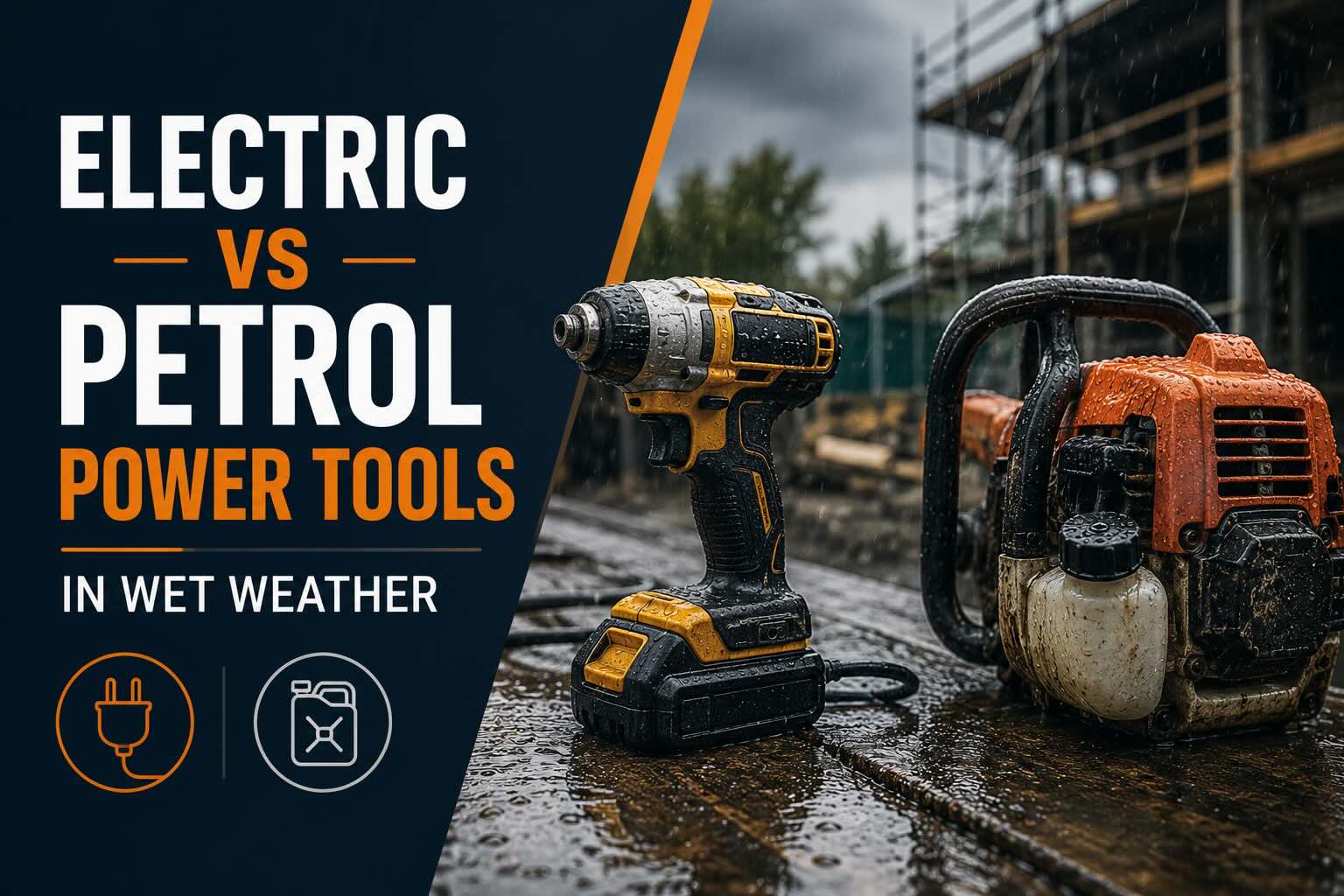
If you work outdoors in the UK, you work in the rain. There's no getting around it — November through March, you'll see more wet days than dry ones, and even in summer you'll get caught out. So when the conversation turns to switching from petrol tools to high-end cordless or mains electric alternatives, the question every tradesperson rightly asks is: will it cope?
This guide gives you a direct, honest comparison across the categories that matter for outdoor tradespeople in genuinely wet conditions. We're not talking about damp — we're talking about the kind of steady horizontal drizzle that turns a Cheshire housing estate into a bog by 8am.
The IP Rating Basics You Need to Know
Before comparing specific tools, you need to understand IP ratings, because they're what manufacturers use to define water resistance — and they're often misunderstood.
IP stands for Ingress Protection. The second digit is what matters for water:
- IPX3: Protected against spraying water at up to 60° from vertical. Fine for light rain.
- IPX4: Protected against water splashing from any direction. Adequate for most UK rain.
- IPX5: Protected against water jets. Good for exposed conditions.
- IPX7: Can be submerged in up to 1m of water for 30 minutes. Overkill for most applications, but it exists.
Petrol tools have no IP rating because they were never designed for one — water gets into a petrol engine via the air intake, and manufacturers assume you won't be running a chainsaw in a swimming pool.
Modern cordless tools from premium manufacturers — Milwaukee, DeWalt, Makita, Festool — are increasingly offering IPX4 or better protection. The Milwaukee M18 FUEL range, for example, carries IPX4 ratings across most of its lineup. The DeWalt XR line is similar.
Head-to-Head: Circular Saws
Petrol (Husqvarna K760, Stihl TS420)
Petrol cut-off saws and circular saws are absolute workhorses for groundworkers, pavers, and builders doing structural cuts. They produce around 4–5kW of raw power, can run indefinitely as long as you have fuel, and aren't fazed by running in the rain because the engine is sealed and the exhaust is exposed anyway.
The problem with petrol in wet conditions:
- Starting can be unreliable when the choke is wet or the air filter damp
- Two-stroke fuel mixture needs to be fresh — old mix in a wet environment causes starting issues
- Condensation in the fuel tank over winter is a persistent problem
- Vibration and noise are significant — you're required to log vibration exposure under HAVS regulations
Running cost: Petrol plus two-stroke oil runs around £1.80–£2.20 per litre effective cost. A K760 burns roughly 0.6–0.8L per hour under load, so call it £1.20–£1.76 per hour just in fuel.
Cordless (Makita XGT 40V, Milwaukee M18 FUEL)
The Makita 40V XGT circular saw delivers 5,000 RPM and cuts 77mm at 90°. In dry conditions it matches a petrol equivalent on a 6Ah battery for around 35–50 minutes of cutting. In cold wet conditions, battery performance drops — typically 15–25% capacity reduction at 5°C, and up to 35% at 0°C.
The reality in UK winter rain: The Makita XGT series carries IPX4 ratings and is specifically tested for use in wet environments. The battery contacts are sealed and the motor housing is designed with drainage channels. In real-world testing by site workers, these tools handle persistent UK rain without issue — the problem isn't the rain, it's the cold reducing battery run time.
The solution: Carry two or three 6Ah batteries rotated through a van charger. Modern chargers (the Makita DC40RA, for example) also function as battery warmers at low temperatures, maintaining performance. The Milwaukee M18 REDLITHIUM batteries have integrated cell temperature management that reduces cold-weather drop-off compared to cheaper alternatives.
Running cost: A 6Ah M18 battery costs roughly 8p to fully charge at current UK electricity rates (£0.25/kWh). Even accounting for charging from a van inverter with efficiency losses, you're looking at 15–20p per full charge versus £1.50+ per hour of petrol.
Verdict: For most cutting applications, premium cordless now matches petrol in wet weather with the right battery management. For all-day continuous cutting (road surfacing, major groundworks), petrol still wins on endurance.
Head-to-Head: Angle Grinders
Petrol Equivalents Don't Really Exist Here
Angle grinders are almost universally electric or cordless. This is one category where the comparison is corded mains electric versus cordless — and mains electric and standing water don't mix.
This is the area where the argument for cordless is most compelling in wet weather. A corded 110V site grinder on a transformer is technically safe — 110V centre-tapped earth systems mean the maximum shock voltage is 55V — but running 16m of orange extension lead across a wet site, through puddles, to a CTE transformer that's sitting on a pallet in the rain, creates real hazards.
A fully-sealed cordless grinder with an IPX4+ rating eliminates that risk entirely. The Milwaukee M18 FUEL and DeWalt FlexVolt grinders both deliver power comparable to 900W corded tools and work in rain without issue.
Practical note: Always check that cutting and grinding discs are rated for the RPM of your tool, and check them for damage before use — a cracked disc is a cracked disc whether the tool is electric or petrol.
Head-to-Head: SDS Drills and Demolition Hammers
The Petrol Case
There are petrol-driven rock drills and demolition hammers — Wacker Neuson, Bosch, Hilti — used in heavy groundworks and quarrying. These are specialist kit. For most builders, electricians, plumbers, and general tradespeople, this comparison doesn't apply.
Cordless SDS in Rain
The Milwaukee M18 FUEL SDS Plus (2712-20), DeWalt 18V XR, and Makita 40V XGT SDS drills all carry IPX4 minimum ratings. They're used daily on UK building sites in all weather.
The main concern from tradespeople is hammer mechanism reliability when water ingresses. In practice, with proper tool maintenance — blowing out the chuck and chuck key hole, applying a small amount of grease to the SDS shank before insertion — these tools hold up over multi-year outdoor use.
What fails first: The battery terminal area. Water sitting in the tool body's battery receptor can cause corrosion over time. The fix is simple: when storing tools in the van overnight, flip them battery-down so water drains out rather than pooling at the terminals. This one habit extends cordless tool life significantly.
The Safety Argument: Electric Wins Clearly
Beyond performance, there's a compelling safety case for moving away from petrol tools on sites where other tradespeople are working.
Carbon monoxide: Petrol tools produce CO. In any partially enclosed environment — under a scaffold deck, inside a garage with a door partially shut, in a covered trench — CO builds up fast and silently. There are fatalities every year from CO poisoning related to petrol tool use in semi-enclosed spaces. Electric tools produce zero CO.
Fire risk: Petrol and refuelling near any heat source, cutting spark, or electrical equipment creates fire risk. Particularly relevant for electricians, gas engineers, and anyone working near existing gas or electrical services.
Fuel spillage: A cracked petrol can or a poor refuelling connection leaves fuel on the ground. On a client's driveway, in their garage, or near a drain, this is an environmental liability as well as a fire hazard.
Vibration: Electric tools — particularly brushless motor designs — typically have lower vibration levels than petrol equivalents. Under HAVS regulations, you have a daily vibration exposure action value of 2.5 m/s² A(8). Many petrol tools breach this limit within 2–3 hours of continuous use. This matters for long-term health and for your insurance and HSE compliance.
The Cost of Switching
Here's where the honest answer gets uncomfortable for some people: switching a full petrol toolkit to premium cordless is expensive upfront.
A Husqvarna K760 costs around £650–£800. A comparable Makita 40V XGT cordless cut-off saw (with two batteries and charger) costs £400–£550. In that specific case, cordless is actually cheaper.
But if you're running a petrol generator, petrol plate compactor, petrol pump, and petrol cut-off saw — replacing all of them in one go is a £3,000–£5,000 investment. The running cost savings (typically 60–80% lower per hour versus petrol) mean you recoup that over 18–30 months depending on usage, but the upfront hit is real.
The pragmatic approach: Don't replace petrol tools that are working fine. Replace them when they wear out or need major servicing. Budget for the cordless equivalent at replacement time, factor in battery platform compatibility (choose one manufacturer's 18V or 40V platform and stick to it so batteries are interchangeable), and phase the transition over 2–3 years.
Keeping your kit organised and logged — so you know what you have, what needs replacing, and what you've spent — is exactly the kind of business admin that tools like Sleepless Tradesman help take off your plate, so you can focus on decisions like these rather than digging through receipts.
Wet Weather Maintenance: What You Must Do
Whether you're using petrol or electric tools, working in rain accelerates wear if you ignore maintenance.
After every wet day:
- Wipe down cordless tools with a dry cloth, paying attention to the battery connection area
- Remove batteries from tools when not in use and store them at room temperature
- Check power tool air vents — if grit or swarf has been sucked in, blow it out with compressed air before it dries and blocks the motor cooling
- For petrol tools: drain the carburettor bowl if the tool won't be used for more than a week
Monthly:
- Check all cutting discs, blades, and bits for damage — wet conditions accelerate metal fatigue
- Lubricate SDS chucks and check for corrosion
- Inspect all power cables (corded tools) for nicks or abrasion in the sheath
FAQ
Are cordless tools actually safe to use in rain?
Premium cordless tools from manufacturers like Milwaukee, Makita, and DeWalt carry IP ratings specifically designed for outdoor and wet conditions — typically IPX4 or higher. This means they can handle rain splashing from any direction. You should not submerge them or use them in standing water, but UK rain and site conditions are within their design parameters. Always check the IP rating on your specific tool before use in wet conditions.
My petrol tool won't start in cold wet weather — what's the issue?
The most common causes are: a damp air filter restricting airflow, stale or incorrectly mixed fuel, a choke that isn't seating properly due to condensation, or a spark plug that's fouled or wet. Carry a spare spark plug, use fresh fuel mixed at the correct ratio, and store petrol tools in a dry environment (your van, not an open trailer) overnight. If the problem is persistent, a carburettor clean and rebuild is often the fix.
How much does it actually cost to run cordless tools versus petrol per day?
For a typical mixed day of drilling, cutting, and grinding: a petrol setup might consume £8–£15 in fuel. A comparable cordless setup costs £0.50–£1.50 in electricity, even accounting for charging from a van inverter with conversion losses. The cordless cost saving is typically 80–90% on energy alone, which over a working year represents a meaningful saving that offsets the higher upfront cost of premium cordless kit.
Do I need a special charger to charge batteries from my van?
Yes. You need either a pure sine wave inverter (not a modified sine wave inverter — these can damage battery chargers) rated for at least 300W for a single charger, or a 12V/24V direct charger designed for your specific battery platform. Some manufacturers, including Makita, sell dedicated 12V vehicle chargers for their cordless platforms. Running a standard mains charger through a quality 500W–1000W pure sine wave inverter is the most flexible and commonly used approach.
Ready to work smarter?
Join thousands of tradespeople using AI to save time on quotes, invoices, and job planning.
Try Sleepless Tradesman FreeRelated Guides
Free resources from our UK tradesperson guide library