Solar Panel Installer Day Rate UK 2026
Written by Tom Ellis · Senior Trades Editor
Last updated: August 2026
Quick Answer
Solar panel installers in the UK charge between £220 and £420 per day in 2026, depending on location, qualifications, and system complexity. The national average for a fully qualified installer is £250 to £350 per day (around £30 to £45 per hour). MCS-certified installers command a premium of £300 to £420 per day, while battery storage specialists can reach £500 per day on complex jobs.
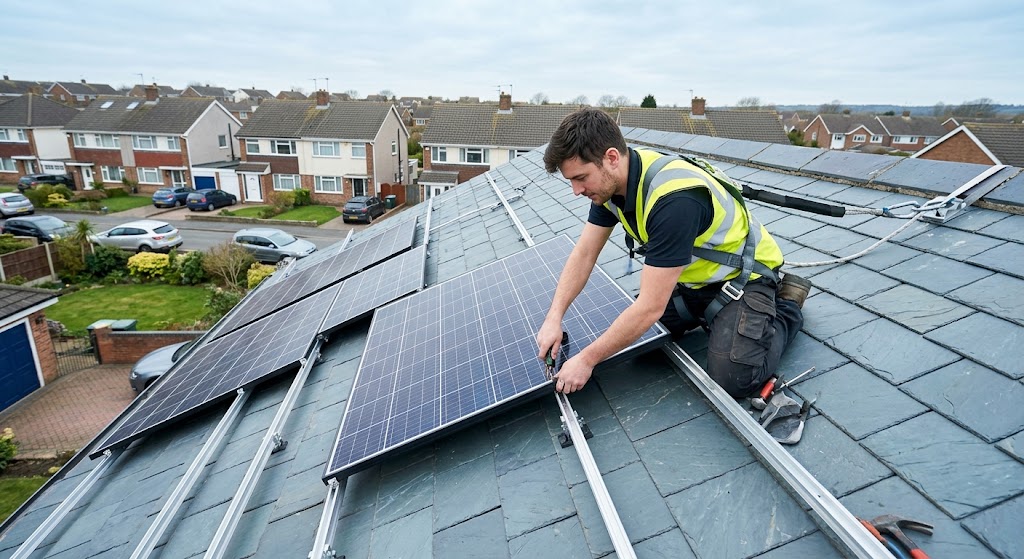
What does a solar panel installer do?
A solar panel installer (also called a photovoltaic, or PV, installer) fits solar panels to residential and commercial roofs, connects them to the building's electrical system, and commissions the system so it feeds electricity back to the grid or into a battery. The role spans multiple trades: structural roof work, DC wiring, AC grid connection, and increasingly, battery energy storage integration.
A typical domestic job involves surveying the roof, mounting rails and panels, running DC cables to the inverter location, connecting the AC side, configuring monitoring, and completing MCS paperwork. Commercial jobs add grid protection relay settings, Distribution Network Operator (DNO) notifications, and often structural engineer sign-off for larger arrays.
Because the role sits at the intersection of electrical and construction work, experienced solar installers often hold a JIB/ECS gold card for their electrical competency alongside their MCS accreditation. This dual qualification is one reason rates have risen sharply since 2023: qualified labour is genuinely scarce relative to the volume of installs the UK government targets under its net-zero strategy.
For a broader overview of what tradespeople charge across different disciplines, see our UK tradesman day rates guide for 2026.
Solar installer day rates by UK region
Labour costs vary considerably across the UK. London and the South East attract the highest rates, driven by higher living costs and stronger residential property values. Rates in Wales, the North East, and parts of Scotland are typically 30 to 35 per cent lower than in the capital, though the gap has narrowed as MCS-certified installers become harder to find everywhere.
The figures below reflect day rates for a single qualified installer. Where a job requires a team, multiply accordingly or use the system-size table further down this page.
| Region | Day rate | Hourly equivalent |
|---|---|---|
| London | £320 – £420 | £40 – £53 |
| South East | £300 – £400 | £38 – £50 |
| South West | £260 – £360 | £33 – £45 |
| Midlands | £240 – £340 | £30 – £43 |
| North West | £220 – £320 | £28 – £40 |
| North East | £210 – £310 | £26 – £39 |
| Scotland | £220 – £320 | £28 – £40 |
| Wales | £210 – £300 | £26 – £38 |
Rates are for a single qualified self-employed installer (labour only, excluding materials and scaffold). Based on an 8-hour working day.
Day rate by qualification and certification
Qualification is the single biggest driver of day rate variation in the solar sector. MCS certification is the kite-mark that unlocks Smart Export Guarantee (SEG) eligibility for homeowners, so it commands a meaningful premium. Battery storage specialists sit at the top of the rate scale because demand for battery retrofits and new hybrid systems has outpaced the supply of trained engineers.
| Qualification level | Typical day rate | Notes |
|---|---|---|
| Unqualified assistant / labourer | £120 – £180 | No formal solar qualification; assists with panel lifting and cable runs |
| Level 3 NVQ (Electrical/Renewables) | £220 – £320 | Qualified to carry out installations under supervision of MCS lead |
| MCS certified installer | £300 – £420 | Required for customers to claim SEG payments; most in-demand tier |
| Battery storage specialist | £350 – £500 | High demand due to battery market growth; G99 / G100 competency often required |
Installation day rates by system size
Most solar installations are priced as a fixed project quote rather than a daily hire arrangement. However, understanding the underlying day-rate logic helps both installers pricing their own work and customers assessing whether a quote is fair. The table below shows indicative team day rates for different system sizes; the total project price will be the day rate multiplied by the number of installation days, plus materials, scaffolding, and certification costs.
| System size | Team day rate (labour only) | Typical duration | Notes |
|---|---|---|---|
| 1 – 4 kW domestic | £400 – £800 per day (team of 2) | 1 – 2 days | Standard home install; most common residential job |
| 5 – 10 kW domestic / small commercial | £600 – £1,200 per day (team of 2 – 3) | 2 – 3 days | Larger roof arrays; may require scaffolding hire on top |
| 10 kW+ commercial / flat-roof | £900 – £1,800+ per day (team of 3 – 4) | 3 – 5+ days | G99 notification, structural survey, and DNO liaison usually required |
Labour only. Materials (panels, inverter, mounting, cabling) and scaffolding are separate costs. Commercial jobs may also incur DNO application fees.
What affects solar installer rates?
Several factors push rates up or down from the regional averages above.
- MCS certification status: MCS-accredited installers can issue the certificate required for SEG applications. This is a legal requirement in practice, and homeowners know it, so certified engineers command a 15 to 25 per cent premium over uncertified counterparts.
- Battery storage competency: Adding a battery (such as a Givenergy, Tesla Powerwall, or SolarEdge battery) to a solar install requires additional DC and AC wiring skills, G99 relay settings on larger systems, and sign-off paperwork. Engineers qualified for battery work typically charge an additional £50 to £100 per day over their base PV rate.
- Roof type and access difficulty: Flat roofs, slate roofs, and properties with restricted access add complexity. An installer may charge a day rate premium of £50 to £150 for particularly difficult access, or the quote will include extra labour days.
- Scaffolding and working at height:Solar installers do not always include scaffold hire in their day rate. Scaffolding for a typical two-storey house costs £400 to £800 for a week's hire. Confirm with any installer whether scaffold is in or out of their quote.
- DNO applications and grid protection: Larger systems (typically above 3.68 kW single-phase) require a G98 or G99 notification to the Distribution Network Operator. G99 applications, which include detailed technical documentation, can take several weeks to process and often require an additional engineering fee of £200 to £500 on top of the installation day rate.
- Season and demand: Solar installation demand peaks in spring and early summer when daylight hours improve and homeowners want systems commissioned. Rates can climb 10 to 15 per cent in peak season when installer diaries are full and waiting lists stretch to several months.
- Travel and call-out distance: Most self-employed installers charge for travel beyond 30 to 40 miles. Expect an additional £0.45 to £0.60 per mile beyond that radius, or a fixed travel day if the job site is more than two hours from their base.
If you are quoting solar work for the first time and want to work out how to price a job correctly, see our guide on how to price a job as a tradesman in the UK, which walks through margins, overheads, and markup on materials in detail.
Employed vs self-employed solar installer rates
The distinction between employed and self-employed solar installers matters both for how rates are structured and for what installers actually take home.
Employed installers working for a solar installation company or energy contractor typically earn a PAYE salary. In 2026, employed solar installers with MCS certification earn roughly £32,000 to £48,000 per year (£170 to £250 per day equivalent), with pension contributions, holiday pay, and sick pay included. Senior engineers and team leaders at larger firms can earn £50,000 to £60,000.
Self-employed installers charge the higher day rates shown in the tables above, but out of that income they must fund: public liability and professional indemnity insurance (typically £800 to £1,500 per year for a solar installer), MCS annual renewal fees, tool and vehicle costs, accountancy fees, and periods without income between jobs. Industry rule of thumb: multiply a PAYE salary by 1.4 to 1.6 to get the self-employed equivalent that delivers the same net income.
Many experienced solar installers operate via a limited company rather than as sole traders. This allows them to be tax-efficient with dividends and salary splitting, but adds accountancy costs of around £1,000 to £2,000 per year. If you are working out which route makes most financial sense, our hourly rate calculator can help you model what you need to charge to hit your target net income after overheads and tax.
Solar installers who hold a full electrical qualification often supplement their income with domestic electrical work in quieter periods. If you want to compare solar rates with the broader electrical trade, see our electrician hourly rate guide for 2026.
Frequently asked questions
What is the average day rate for a solar panel installer in the UK in 2026?
The national average sits between £250 and £350 per day for a qualified, self-employed solar panel installer. MCS-certified installers typically command £300 to £420 per day, while battery storage specialists can reach £500 per day on complex jobs.
Do solar installers charge per panel or per day?
Most self-employed solar installers quote a day rate or a fixed project price rather than a per-panel charge. A fixed quote typically rolls in travel, access equipment, materials uplift, and certification paperwork. Day rates are more common when a solar firm brings in a freelance installer as additional labour.
Do I need an MCS-certified installer?
Yes, if your customer wants to receive Smart Export Guarantee (SEG) payments for their surplus electricity, the installation must be carried out by an MCS-certified contractor. MCS certification is also required for most RECC warranty schemes and many mortgage lender conditions for newly built properties.
How does solar installer pay compare to a standard electrician?
Solar installers with MCS certification typically earn 10 to 20 per cent more than a general domestic electrician. A standard domestic electrician earns around £220 to £350 per day, while an MCS-certified solar installer commands £300 to £420. Many solar installers hold a dual qualification, carrying both a JIB/ECS card and their MCS accreditation.
Can a solar installer work as self-employed?
Yes. The majority of experienced solar installers operate as sole traders or through limited companies. Self-employed rates are generally 20 to 40 per cent higher than the equivalent PAYE wage because the installer covers their own insurance, MCS renewal fees, tools, and vehicle costs. When quoting customers, self-employed installers must remember to factor in those overheads.
What qualifications do you need to install solar panels in the UK?
At minimum, solar installers need a Level 3 NVQ or equivalent in Electrical Installations or Renewable Energy. For domestic grid-connected systems, you also need MCS certification (or to work under an MCS-certified company). Battery systems require an additional competency in energy storage, and larger commercial arrays typically need G99 or G100 competency recognised by the Distribution Network Operator.
Related guides: UK tradesman day rates 2026 · Electrician hourly rate UK 2026 · How to price a job · Hourly rate calculator