EV Charger Installation Cost UK 2026: £800-1,500 for a Home Wallbox (Including Grant)
Written by Tom Ellis · Senior Trades Editor
Last updated: July 2026
Quick Answer
A home EV wallbox charger costs £800-1,500 installed in the UK in 2026. The OZEV grant (Electric Vehicle Chargepoint Grant) provides £350 off for eligible properties, reducing the cost to £450-1,150. A 7kW smart charger is standard for home use. Approved installers must be OZEV-registered to claim the grant on your behalf.
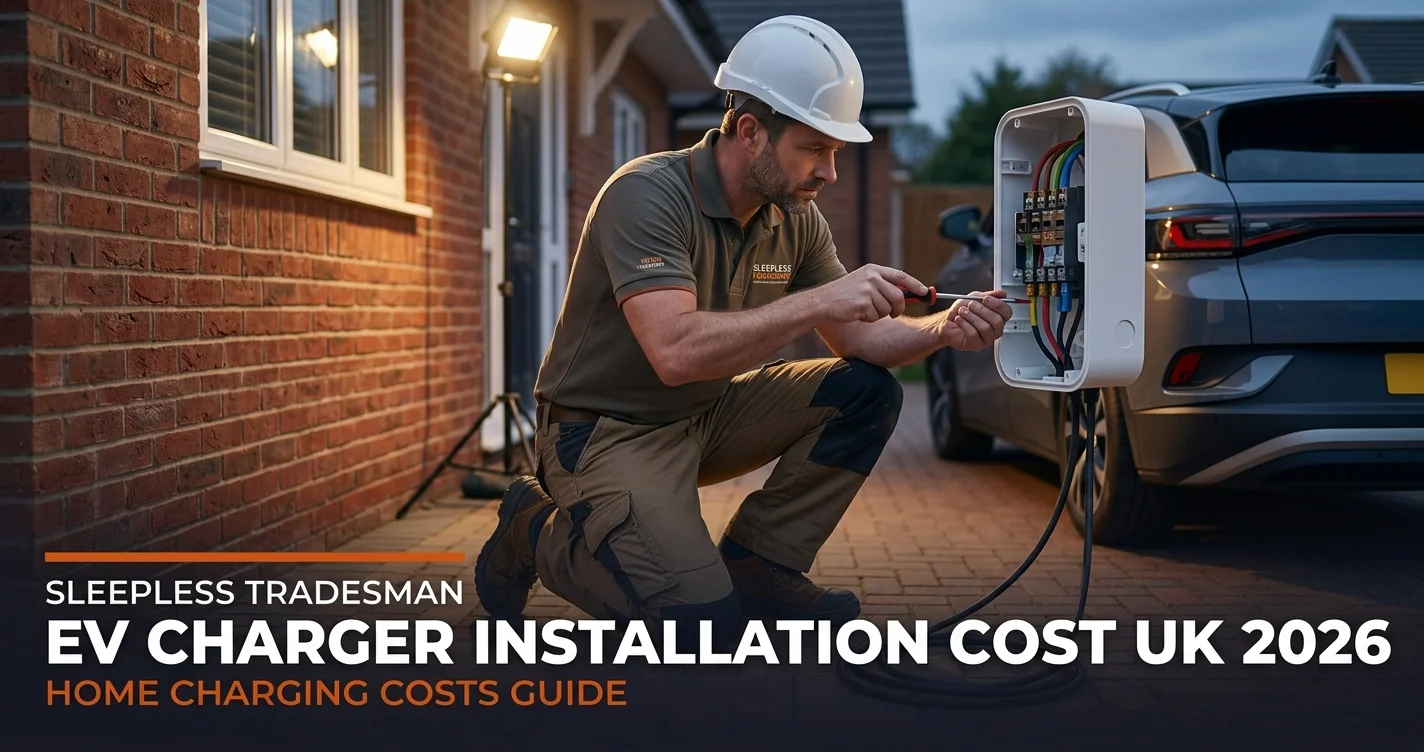
Electric vehicles are rapidly becoming the norm on UK roads, and demand for home EV charger installation has surged as a result. Whether you are an electrician looking to understand the market you are working in, or a homeowner trying to work out what a fair price looks like before you invite quotes, this guide covers everything you need to know about EV charger installation costs in the UK in 2026.
The headline figure of £800-1,500 covers a standard 7kW home wallbox, fully installed, including the unit itself. That is the complete cost you should expect to pay a qualified electrician, with no hidden extras for a straightforward job. Where costs vary, they tend to vary for specific and predictable reasons: the distance the cable needs to run from your consumer unit, whether containment needs to be clipped across a wall or buried underground, which brand and model of charger you choose, and whether you qualify for the OZEV government grant that takes £350 off the total.
It is also worth understanding what is driving the variation in installer prices right now. The shift to electric vehicles has attracted a wave of new entrants to EV charger installation, including some who quote unusually low prices and cut corners on cable sizing, earthing, or smart charging configuration. At the same time, established electrical contractors with OZEV registration are seeing strong demand and can command a premium for their expertise and the grant eligibility they unlock. Knowing what a legitimate quote looks like protects you from both overcharging and underdelivering.
For electricians reading this, the EV charger installation market is one of the most active growth areas in domestic electrical work in 2026. The job itself is typically a half-day to full-day task with a solid materials margin, and OZEV registration opens the door to the government grant scheme, which makes you the preferred choice for a large proportion of potential customers. Our electrician hourly rate guide covers typical day rates in more detail, but EV charger work generally falls in the £200-£450 labour range depending on complexity and region. Electricians expanding into solar panel work alongside EV charging will find trade-specific quoting advice in our guide to the best quoting app for solar panel installers.
This guide covers home wallbox costs, commercial charger pricing, what the OZEV grant covers in 2026, the key factors that push prices up or down, how to compare quotes properly, and answers to the most common questions we see from both homeowners and tradespeople.
Homeowners who are also considering solar panels alongside an EV charger will find relevant contractor rates in our solar panel installer day rate guide.
EV Charger Installation Cost UK 2026: Price Table
The table below shows typical installed costs for different EV charger types in the UK in 2026. All prices include supply and installation. Grant figures reflect the current OZEV Electric Vehicle Chargepoint Grant of £350.
| Charger Type | Installed Cost | With Grant |
|---|---|---|
| 7kW tethered wallbox (standard) | £800-1,100 | £450-750 |
| 7kW untethered wallbox | £900-1,200 | £550-850 |
| 22kW 3-phase charger | £1,200-2,000 | Not eligible (home use) |
| Commercial 22kW (Type 2) | £1,500-3,500 | LEVI grant available |
Prices correct as of June 2026. Regional variation applies. See our EV charger cost calculator for a personalised estimate.
What Is Included in the Price
A properly quoted EV charger installation should include all of the following as standard. If a quote is significantly lower than the range above, check whether any of these items have been excluded or whether a less capable charger unit is being supplied.
- Charger unit supply: The wallbox itself, typically a 7kW smart charger from a reputable brand such as Ohme, Zappi, Hypervolt, or Wallbox. Smart chargers allow time-of-use tariff scheduling, load management, and app connectivity.
- Installation labour: Typically 3-6 hours for a standard job. This includes mounting the unit, running and connecting cable from the consumer unit, testing, and commissioning.
- Cabling from consumer unit: A dedicated circuit from your fuse board to the charger location. The cable size and route will vary depending on the distance and the route available.
- CT clamp or demand side management: A current transformer clamp is fitted to monitor the overall load on your supply, so the charger automatically reduces its output if your home is approaching the supply limit. This is a regulatory requirement under OZEV.
- OZEV grant application: If you are eligible, your installer should submit the grant application on your behalf. The £350 is deducted from your invoice directly. You never pay the full amount and then claim it back.
- DNO notification: Your installer is responsible for notifying the Distribution Network Operator if required. This is handled as part of a proper installation and should not be an add-on.
What Is Not Included
Some additional costs can arise depending on your property and circumstances. These should be quoted separately and itemised clearly before work starts.
- Groundworks to bury a cable: If your charger needs to be installed on a detached garage or in a position that requires the cable to cross a garden, it will usually need to be buried in armoured conduit. Groundworks to dig, lay, and reinstate the trench typically add £200-800 depending on distance and surface type.
- Consumer unit upgrade: If your fuse board is old, lacks sufficient ways for a new circuit, or does not have an RCD protecting the new circuit, an upgrade will be required before the charger can be connected safely. Consumer unit upgrades typically cost an additional £400-800.
- Additional metering for business use: If you intend to reclaim electricity costs as a business expense, you may need a separate sub-meter on the EV circuit. This is not required for personal use.
Key Factors That Affect the Price
Most of the variation between quotes comes down to five core factors. Understanding these will help you assess whether a quote is fair or whether a lower price is concealing shortcuts.
- OZEV grant eligibility: If you qualify for the £350 Electric Vehicle Chargepoint Grant, your effective cost is immediately reduced. Eligibility in 2026 applies to residents of flats and rental properties, and certain benefit recipients. Homeowners in houses no longer qualify for the domestic grant. Commercial properties may be eligible for the LEVI fund.
- Cable run distance: The further the charger is from your consumer unit, the more cable, trunking, and labour time is needed. A charger installed on a garage wall directly adjacent to the house is a much simpler job than one at the far end of a drive 20 metres away.
- Cable route and containment: Running cable through a loft and down an external wall is straightforward. Burying it underground, drilling through thick stone walls, or fitting extensive surface-mounted conduit all add time and materials.
- Charger brand and model: Entry-level smart chargers from brands such as Andersen or Pod Point start at around £500-600 supplied. Premium options like the Zappi (with solar diversion built in) or the Hypervolt Home 3 carry higher unit costs, typically £700-900, pushing the total installed cost toward the upper end of the range.
- Single-phase vs three-phase supply: The vast majority of UK homes have a single-phase electricity supply, which limits home EV charging to a maximum of 7kW. If your property has a three-phase supply (common in larger commercial or rural properties with generator setups), a 22kW charger is possible, but the unit and installation costs are significantly higher.
Regional Price Variation Across the UK
EV charger installation costs are not uniform across the UK. Labour rates for electricians vary significantly by region, and those differences feed directly into your installation quote. The national average figures in the table above reflect a mid-England benchmark. Here is how prices typically compare across the country.
- London: Expect to pay 25-35% above the national average. High installer labour rates, parking and access costs in urban environments, and stronger demand all push prices up. A standard 7kW tethered wallbox that costs £900 nationally might cost £1,100-1,200 in London before the grant.
- South East (Surrey, Kent, Hampshire, Berkshire): Typically 15-20% above the national average. Good installer availability, but strong demand from a high density of EV ownership keeps prices elevated relative to other English regions.
- Midlands and East of England: Close to the national average. Healthy competition among installers and reasonable labour rates mean the cost table figures above apply reasonably well without adjustment.
- North of England (Yorkshire, Lancashire, North East): Typically 5-10% below the national average. Lower general electrician labour rates in these regions mean competitive pricing, particularly from independent sole traders.
- Wales and Scotland: Also typically 5-10% below the national average in most areas, though remote rural locations can see higher costs due to travel time and reduced installer competition.
For tradesmen, these regional differences matter for how you price your work. Use our hourly rate calculator to benchmark your labour rate against the going rate in your area.
How to Get an Accurate Quote
Getting a fair and accurate quote for EV charger installation is straightforward if you know what information to prepare and what to ask. The single most common cause of quotes coming in higher than expected is a surveyor arriving to discover a more complex cable run than was described over the phone. Give installers as much information as possible upfront to avoid revised quotes after the work has started.
Information to have ready
- Where your consumer unit (fuse board) is located and how far it is from where you want the charger installed
- Whether you have a detached or integral garage, and what the wall construction is
- Whether any cable will need to cross a garden, driveway, or path
- Whether you own the property or rent it (affects grant eligibility)
- Whether you have a smart electricity tariff such as Octopus Go or OVO Beyond (affects which charger brands are most compatible)
- Whether you have solar panels and want the charger to divert surplus solar power
What to ask installers
- Are you OZEV-registered and can you apply for the grant on my behalf?
- Is the quote fully installed including all cable, containment, and testing?
- Which charger brand and model is included, and what is the manufacturer warranty?
- Will you handle DNO notification if required?
- Is the CT clamp and demand side management device included?
- What happens if the consumer unit needs work before the charger can be connected?
Getting at least three quotes from OZEV-registered installers is the best way to check that you are paying a fair price. Our electrical load calculator can help you understand whether your current supply can support a new 7kW EV circuit without upgrades.
Tethered vs Untethered: Which Should You Choose?
One of the first decisions you will make is whether to choose a tethered or untethered charger. The difference is simple: a tethered charger has a cable permanently attached to the unit, exactly like a petrol pump. An untethered charger has a socket on the unit, and you plug in your own Type 2 cable.
Tethered chargers are slightly cheaper because the cable is included in the unit price, and they are more convenient for day-to-day use: you just grab the cable and plug in, without having to find and uncoil a separate lead each time. The drawback is that if you change your vehicle and the new one uses a different connector (currently unlikely in the UK, where Type 2 is near-universal, but worth noting), or if the cable is damaged, replacing it means replacing the whole unit.
Untethered chargers give you more flexibility, particularly if multiple different vehicles use the same charger, or if you prefer to keep the cable stored in the car. They are slightly more expensive due to the socket unit design, but the price difference is typically only £100-200 in the installed cost. For most homeowners with a single EV, a tethered charger is the practical choice.
Frequently Asked Questions
Am I eligible for the OZEV EV charger grant?
The Electric Vehicle Chargepoint Grant (EVCP) provides £350 off a home charger for people who live in flats or rental accommodation, or who are receiving certain benefits. Homeowners in houses are no longer eligible for the domestic grant as of 2023. The grant for flats and rental properties remains available and must be applied for by an OZEV-approved installer. Commercial and workplace chargers may be eligible for the LEVI fund. If you are unsure whether you qualify, ask any OZEV-registered installer: they deal with eligibility queries regularly and will be able to tell you quickly whether the grant applies to your situation.
What is the difference between a 7kW and 22kW charger?
A 7kW charger (single-phase, 32A) is the standard home option and will add roughly 30-40 miles of range per hour of charging. A 22kW charger requires a three-phase electricity supply, which is rare in residential UK properties and predominantly found in commercial buildings or rural properties with specific supply arrangements. A 22kW charger adds up to 100 miles per hour of range, making it significantly faster. Most UK homes have single-phase supply, making 7kW the practical maximum at home. The speed difference matters most for high-mileage drivers who return home with a very low state of charge and need to be ready to drive again early the following morning. For the typical domestic user who charges overnight, a 7kW charger is more than adequate.
Do I need planning permission for an EV charger?
No. Installing an EV charger is permitted development in England, Scotland, and Wales, provided the charger is not within 2 metres of a highway and does not face a highway on a listed building. You do not need to inform your local authority. You do need to notify your Distribution Network Operator (DNO) if the charger is above a certain amperage threshold, but your installer handles this as part of a proper installation. If you live in a flat or a leasehold property, you will need to check your lease and obtain freeholder or management company permission before proceeding, as electrical installations to shared parts of a building may require consent regardless of permitted development rights.
Can any electrician install an EV charger?
Technically any qualified electrician can install an EV charger under Part P of the Building Regulations, but only OZEV-approved installers can apply for the £350 grant on your behalf. OZEV approval requires additional EV-specific training and registration with the Office for Zero Emission Vehicles. If you want the grant, you must use an OZEV-registered installer. Ask for proof of registration before agreeing a price. Beyond the grant, OZEV-registered installers also have specific training in smart charger commissioning, demand side management, and the DNO notification process, so the registration is a reasonable proxy for quality and competence in this specific type of work.
How long does EV charger installation take?
A standard wall-mounted home charger typically takes 3-5 hours for a qualified electrician. This covers running cable from the consumer unit, mounting the unit, connecting it, and commissioning the smart functions including app setup and CT clamp installation. If cables need to be buried in the garden or significant containment needs fitting across complex routes, the installation takes 6-8 hours or may require a second day. If the consumer unit needs attention first, that will add further time. Most installers will give you a realistic timeframe when they survey the job, and you should be cautious of any installer who quotes a very short installation time for a complex cable route without explaining how they plan to achieve it.
Ready to get your EV charger installed?
Compare quotes from OZEV-registered electricians in your area. Free, no obligation.
Get free EV charger installation quotes