Auto Electrician Day Rate UK 2026: £340–£480/Day by Region and Specialism
Written by Tom Ellis · Senior Trades Editor
Last updated: August 2026
Quick Answer
A self-employed auto electrician in the UK charges between £340 and £480 per day in 2026, with a national average of around £400 for an 8-hour day. Hourly rates run from £45 to £65 nationally. The growing complexity of modern vehicle electronics, electric vehicle high-voltage systems, and advanced driver assistance systems (ADAS) calibration means experienced auto electricians are in high demand and can command rates toward the top of this range.
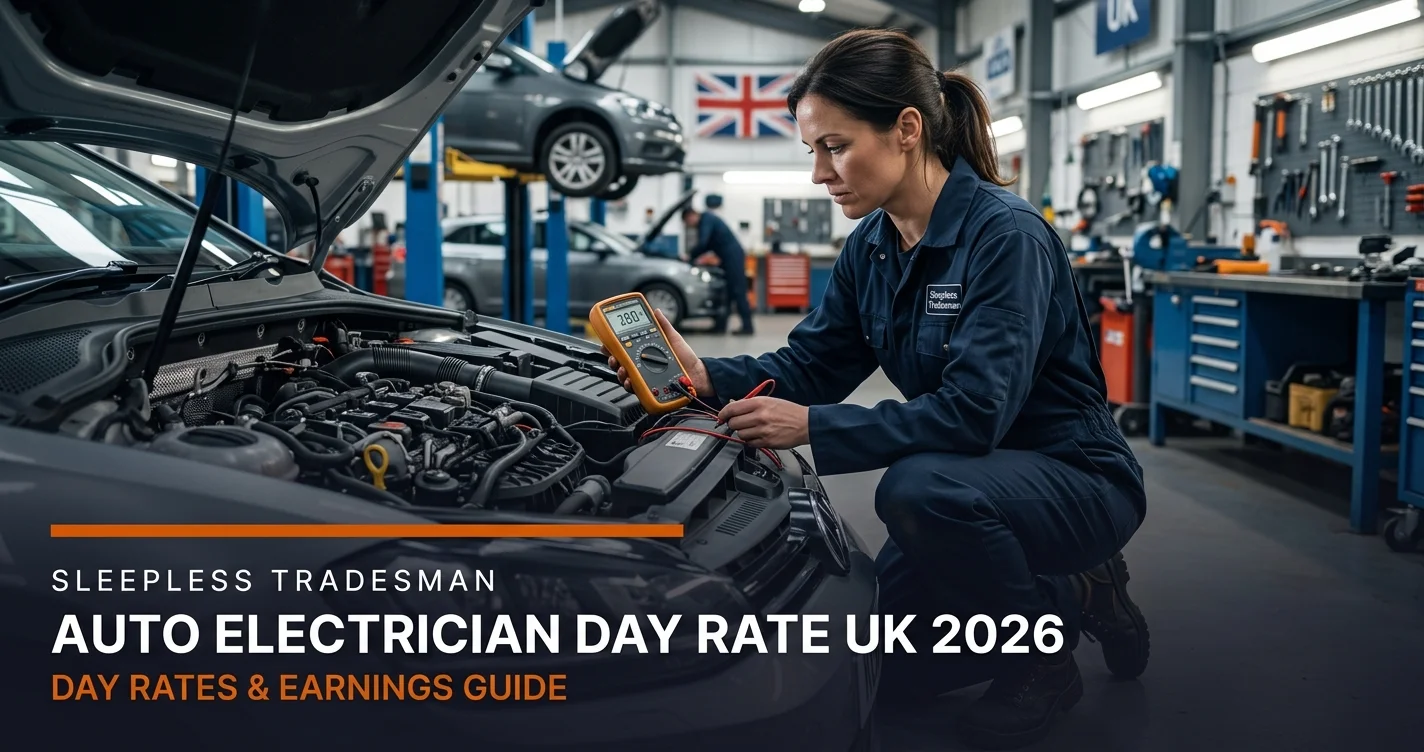
What Drives Auto Electrician Rates in 2026?
Auto electricians are one of the fastest-growing and highest-demand specialisms in the UK automotive trade right now. The combination of increasingly complex vehicle electronics, the rapid expansion of EV and hybrid vehicle registrations, and the growing requirement for ADAS calibration after any windscreen or front-end work has created a skills shortage that is pushing rates upward across the country.
Unlike general mechanics, auto electricians deal primarily with the electrical and electronic systems of modern vehicles: ECUs, wiring looms, CAN bus networks, sensor systems, battery management systems, and increasingly the high-voltage architecture of electric and plug-in hybrid vehicles. This requires a significantly higher level of diagnostic capability and a more expensive tool kit than most other automotive trades. A professional oscilloscope capable of capturing and interpreting automotive waveforms, combined with a multi-make OEM-level diagnostic platform, represents an investment of £5,000 to £15,000 for a well-equipped auto electrician. That investment is reflected in the rates they charge.
The national average rate for a self-employed auto electrician in 2026 sits at around £50 per hour, or approximately £400 per day. That figure sits materially above the equivalent rate for a general mechanic and reflects the specialist nature of the work. At the top end, experienced auto electricians with EV high-voltage qualification (IMI TechSafe Level 3) and ADAS calibration capability can charge £70 to £85 per hour in high-demand areas, or more for specific OEM diagnostic work.
The EV transition is the single biggest factor shaping rates in this sector. Mechanics who invest in IMI TechSafe Level 3 certification for high-voltage EV systems can command a 30 to 50 percent premium over their standard rate for that work. As EVs now account for a growing share of the UK vehicle parc, the demand for qualified HV auto electricians is expected to grow substantially through the rest of this decade. Auto electricians who have not yet begun EV training are in a strong position to differentiate and increase their rates by doing so.
For a comparison of how auto electrician rates sit against other trades, see our UK tradesman day rates guide.
Auto Electrician Rates by Region
The table below shows typical self-employed auto electrician rates across the UK by region for 2026. These figures are calculated from a national average of £50 per hour and reflect standard diagnostic and repair work. EV high-voltage and ADAS calibration work will sit above these figures in most cases.
| Region | Hourly Rate | Day Rate (8 hrs) |
|---|---|---|
| London | £60-85/hr | £480-680 |
| South East | £55-75/hr | £440-600 |
| South West | £46-63/hr | £368-504 |
| East Anglia | £44-60/hr | £352-480 |
| Midlands | £46-63/hr | £368-504 |
| North West | £44-60/hr | £352-480 |
| North East | £40-55/hr | £320-440 |
| Yorkshire | £44-60/hr | £352-480 |
| Wales | £40-55/hr | £320-440 |
| Scotland | £44-60/hr | £352-480 |
| Northern Ireland | £38-52/hr | £304-416 |
Rates are indicative for 2026 and apply to self-employed auto electricians on standard diagnostic and electrical repair work. EV HV and ADAS calibration work will typically sit 20 to 50 percent above these figures.
Auto Electrician Rates by Experience Level
Experience has a pronounced effect on what an auto electrician can charge, more so than in many other trades because the diagnostic complexity of the work increases sharply with experience. A newly qualified auto electrician and one who has been diagnosing intermittent CAN bus faults and programming ECUs for fifteen years represent very different propositions. The table below uses the national average of £50 per hour as the baseline for mechanics in the 3 to 7 year bracket.
| Experience Level | Multiplier | Typical Hourly Rate |
|---|---|---|
| Apprentice / Trainee | 0.6x | ~£30/hr |
| 1-3 years | 0.8x | ~£40/hr |
| 3-7 years (baseline) | 1.0x | £50/hr |
| 7-15 years | 1.15x | ~£58/hr |
| 15+ years / Senior Specialist | 1.3x | ~£65/hr |
These multipliers apply to standard diagnostic and repair work. An experienced auto electrician with IMI TechSafe Level 3 certification working in London or the South East on EV high-voltage systems could realistically charge £90 to £110 per hour for that work specifically, representing a rate that is still strongly competitive against main dealer EV labour charges.
What Affects Your Day Rate as a Self-Employed Auto Electrician?
Auto electrician rates are shaped by a combination of overhead costs, qualifications, the types of work you take on, and your local market. Understanding each of these helps you set a rate that is both commercially sustainable and competitive.
Overhead Costs
Auto electricians carry some of the highest tool and equipment costs in the automotive trades. A professional oscilloscope for automotive waveform analysis costs £500 to £2,000. A full multi-make OEM diagnostic platform capable of accessing manufacturer-level data costs £2,000 to £8,000, often with ongoing annual subscription fees. For those working on EV high-voltage systems, specialist insulated tools and PPE including category 0 rated gloves and insulating mats add another £2,000 to £5,000. A full EV-capable setup for a well-equipped auto electrician runs to £5,000 to £15,000 in diagnostic and safety equipment alone, before accounting for the van, general tools, professional indemnity insurance, and working capital. Total your annual costs, divide by your realistic billable days (typically 200 to 215 per year), and that daily overhead figure must be covered before you have paid yourself anything.
Qualifications and Certifications
IMI Level 3 in Light Vehicle Electrical and Electronic Systems is the industry baseline. For EV work, IMI TechSafe Level 2 is the minimum for low-voltage hybrid systems, while Level 3 is mandatory for safe work on high-voltage EV systems above 60V DC. ADAS calibration training and the associated optical target equipment unlock a fast-growing revenue stream that few independent operators currently offer. Manufacturer-specific certifications such as Bosch ESI partner programmes or Autel certifications can open access to OEM-level diagnostic work at premium rates. Each qualification is an investment that should be reflected in the rate you charge, because it directly enables higher-value work.
Diagnostic Complexity
The diagnostic time required for auto electrical work varies enormously. Fitting an aftermarket accessory or replacing a known-fault component is relatively straightforward. Diagnosing an intermittent fault on a modern vehicle with multiple ECUs and a complex CAN bus network can take four to eight hours of skilled investigation. Most experienced auto electricians charge a diagnostic fee in addition to their hourly rate, or incorporate diagnostic time into their quoted rate for fault-finding jobs. This is appropriate and should be communicated to customers at the outset.
Professional Indemnity and Insurance
Auto electricians should carry both public liability and professional indemnity insurance. Because the work directly affects vehicle safety systems, professional indemnity coverage is particularly important. If a diagnostic recommendation or repair is later found to have caused or contributed to a vehicle fault, having the right cover in place is critical. Premiums will vary based on the type of work you carry out, your turnover, and your qualifications. Our guide on tradesman insurance covers what auto electricians and other specialists need to consider.
How to Set Your Day Rate as a Self-Employed Auto Electrician
The relatively high overhead costs in auto electrical work mean that setting your rate from the bottom up is especially important. Here is a reliable process.
- Set your target net income. Decide what you need to take home annually after income tax, National Insurance, and pension contributions. As a self-employed specialist, your earnings potential is well above average, but so are your upfront costs, so be realistic about the ramp-up period.
- Calculate your realistic billable days. Auto electricians typically see 200 to 215 billable days per year when accounting for holidays, training days, and non-chargeable diagnostic investigation time. Diagnostic work that does not result in a repair is still chargeable, but managing customer expectations around this takes time to establish.
- Total your annual overheads. Include diagnostic equipment depreciation and subscriptions, van costs, specialist PPE for EV work, insurance premiums, certification renewals, and accountancy fees. Divide by billable days for your daily overhead contribution.
- Benchmark against the local market. Use our day rate calculator to compare your target rate with typical rates in your area. If you are offering EV capability or ADAS calibration that local competitors do not, you have a genuine basis for charging above the market average.
- Build in annual review. Tool software subscriptions, insurance premiums, and training costs all tend to increase annually. Set a reminder to review your rate each tax year. See our guide on how to increase your day rate for practical advice on communicating a rate increase to existing clients.
Our hourly rate calculator walks through all these inputs and produces a suggested rate, and the guide on how to price a job covers how to structure individual diagnostic and repair quotes.
Auto Electrician Specialisms and Premium Rates
Auto electricians have more specialist pathways available to them than most other automotive trades. Each specialism carries a meaningful rate premium that reflects the additional investment in training and equipment.
- +EV High-Voltage Diagnosis and Repair
IMI TechSafe Level 3 qualified auto electricians working on high-voltage EV systems can charge a 30 to 50 percent premium above their standard rate. This is the single largest rate premium available in the automotive trade right now and reflects genuine safety complexity, mandatory specialist equipment, and a significant skills shortage. As EV numbers on UK roads grow, this premium is expected to hold or increase through 2027 and beyond.
- +ADAS Calibration
Advanced Driver Assistance Systems calibration requires specialist optical targets, software platforms, and a precise working environment. Any replacement of a windscreen, front-facing camera, radar sensor, or front bumper assembly on a modern vehicle with ADAS typically requires calibration to restore correct function. This work attracts a 25 to 40 percent premium and is in growing demand from both body shops and independent garages that cannot perform calibration in-house.
- +ECU Remapping and Programming
ECU remapping for performance or economy, and ECU programming for replacement modules, attracts a 10 to 20 percent premium. Many auto electricians charge ECU work as a separate project fee rather than folding it into their standard hourly rate, which can improve overall margin on these jobs.
- +Vehicle Security and Tracking Systems
Fitting Thatcham-approved security systems, GPS tracking devices, and immobilisers is a well-established revenue stream for auto electricians. Rates typically sit 10 to 15 percent above standard hourly work, and the supply-and-fit model often allows for additional margin on the hardware itself.
- +Fleet Telematics Installation
Installing and commissioning telematics systems across a fleet of commercial vehicles is an attractive contract for auto electricians. Fleet operators pay a 15 to 20 percent premium for efficient, reliable installation across multiple vehicles, and the relationship often leads to ongoing maintenance and support work.
- +Classic Vehicle Rewiring
Full or partial rewiring of classic and historic vehicles is a premium specialism that commands 20 to 30 percent above standard rates. The work requires patience, attention to period-correct detail, and the ability to diagnose and resolve faults in ageing wiring systems with little or no documentation. Owners of classic vehicles are typically discerning customers who value expertise and are not primarily price-driven.
Frequently Asked Questions
How much does an auto electrician charge per day in the UK in 2026?
A self-employed auto electrician in the UK charges between £340 and £480 per day in 2026, with a national average of around £400 for an 8-hour day. Hourly rates run from £45 to £65 nationally. In London, experienced auto electricians with EV qualifications can charge £85 per hour or more, particularly for specialist high-voltage and ADAS calibration work.
Why do auto electricians charge more than regular mechanics?
Auto electricians command higher rates than general mechanics because the diagnostic and repair work they carry out demands a deeper level of specialist knowledge. Modern vehicle electronics are extraordinarily complex, with multiple ECUs, CAN bus networks, and advanced driver assistance systems that require specialist oscilloscope and OEM diagnostic equipment to diagnose correctly. The investment in tools alone is significantly higher than for mechanical work, with a full EV-capable diagnostic setup running to £5,000 to £15,000. The skill shortage in this specialism also pushes rates upward relative to more common trades.
How much extra do auto electricians charge for EV and hybrid work?
Auto electricians with IMI TechSafe Level 3 qualification for high-voltage EV systems typically charge a 30 to 50 percent premium over their standard rate for EV high-voltage work. This is one of the largest skill premiums in the automotive trade. The premium reflects the cost of specialist HV tools, mandatory insulated PPE, the genuine safety risks involved, and the significant investment in IMI TechSafe certification. For low-voltage hybrid work (IMI TechSafe Level 2), the premium is typically 15 to 25 percent.
What qualifications does an auto electrician need in the UK?
The core qualification is IMI Level 3 in Light Vehicle Electrical and Electronic Systems. For EV and hybrid work, IMI TechSafe Level 2 covers low-voltage hybrid systems (below 60V DC) and Level 3 is required for high-voltage EV systems above 60V DC. ADAS calibration requires separate specialist training and equipment. Manufacturer- specific certifications such as Bosch ESI or Autel partner programmes open access to OEM-level diagnostics and higher-paying work. Professional indemnity insurance is strongly recommended given the safety-critical nature of vehicle electrical systems.
Is ADAS calibration a good addition for a self-employed auto electrician?
Yes, ADAS calibration is a rapidly growing revenue stream for auto electricians. As vehicles with forward-facing cameras, radar sensors, and lane-keeping systems become more common, any windscreen replacement or front-end repair triggers a mandatory ADAS calibration requirement. Specialist optical target equipment and software are required, but the investment can return quickly given the volume of work now coming through independent garages and body shops that do not have calibration capability in-house. The lack of qualified operators in most local markets means this work typically commands a significant premium and is relatively easy to win.
How much does it cost to set up as a self-employed auto electrician?
Initial setup costs for a self-employed auto electrician are typically higher than for most other automotive trades. A professional oscilloscope costs £500 to £2,000, a multi-make OEM diagnostic platform runs £2,000 to £8,000, high-voltage EV tools and PPE add another £2,000 to £5,000 for those doing HV work, plus van, general tools, insurance, and working capital. A realistic minimum setup for a capable mobile auto electrician is £15,000 to £25,000, though many spread these costs over time by starting with the essentials and adding specialist equipment as work grows. The return on investment is strong given the rates the specialism commands once established.
Work Out Your Rate in Minutes
Use our free tools to calculate your hourly and day rate based on your actual overhead costs, target income, and billable days per year.
Related Guides