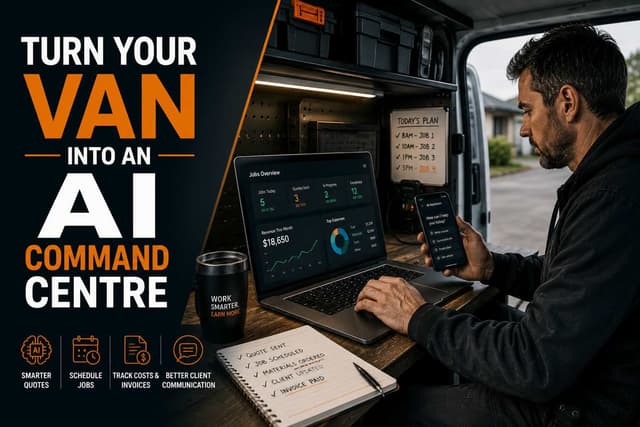
The AI Upskill Roadmap For Plumbers And Electricians To Scale Their Business Fast
AI isn't replacing tradespeople — it's creating a gap between those who use it and those who don't. Here's a practical roadmap for plumbers, electricians, and other tradespeople to use AI to scale their business in 12 months.
Written by Tom Ellis · Senior Trades Editor
Last updated: 25 May 2026

In 2019, the main technology advantage a tradesperson could have over a competitor was having a better website or using accounting software. By 2025, the gap has opened up into something far more significant.
The tradespeople scaling their businesses fastest — from sole trader to 3-person team, from 3-person team to 15-person operation — are using AI tools at every stage of their business: to quote faster, follow up better, manage cash flow in real time, market smarter, and make decisions based on actual data rather than gut feel.
This roadmap is for plumbers, electricians, heating engineers, and other tradespeople who know they should be using these tools but don't have a clear starting point. It's structured as a 12-month programme divided into four quarters, so you can build capability progressively rather than trying to change everything at once.
Why AI Specifically (Not Just 'Technology')
Most tradespeople have used technology for years — smartphones, GPS, accounting software, Checkatrade or MyBuilder. That's not what this is about.
AI tools are different because they can generate rather than just store or display. They can produce a first draft of a quote from your notes, write a professional email response from a brief description, identify patterns in your business data that you'd never spot manually, and respond to client enquiries at midnight without you being awake.
The specific capabilities relevant to a trade business:
- Natural language processing: Understand and respond to text in a human-like way (client communications, complaint handling, enquiry responses)
- Generative text: Produce professional documents — quotes, proposals, job reports — from structured inputs
- Pattern recognition in data: Identify which job types are most profitable, which clients pay fastest, which marketing channels deliver the best leads
- Scheduling optimisation: Given a set of jobs and constraints, suggest the most efficient schedule
None of these require you to understand how AI works any more than you need to understand combustion chemistry to use a gas appliance.
Quarter 1: Foundation (Months 1–3)
Month 1: AI-Powered Quoting
The first and highest-impact AI tool for any tradesperson is AI-assisted quoting. This is where most people's hours go: working out scope, calculating materials, writing it up professionally, and sending it before the client's urgency passes.
Action: Sign up for Sleepless Tradesman or a comparable AI quoting platform designed for UK tradespeople. Commit to using it for every quote for 30 days.
What you'll notice: Your first few quotes using the AI will take almost as long as your old manual process, because you're learning the tool. By week 3–4, you'll be generating professional, detailed quotes in 15–25 minutes rather than 60–90. By month 2, the quality and consistency of your quotes will be noticeably better — and your win rate will start to show it.
Metric to track: Time per quote (before and after), and quote win rate (baseline in month 1, track monthly from there).
Month 2: AI Communication Templates
Most of the messages tradespeople send are variations of a small number of templates: 'I'd like to book a site visit', 'Here's your quote', 'Just following up on the quote I sent', 'Your invoice is attached', 'This invoice is now overdue'.
AI tools — even general purpose ones like Claude or ChatGPT — can generate a library of professional, on-brand versions of each of these that you can save and personalise quickly. More sophisticated job management platforms do this natively.
Action: Spend 2 hours creating a set of 10–15 message templates for the most common client communications in your business. Save them somewhere accessible (your phone's notes, your job management platform, or a simple Google Doc).
The payoff: You stop writing the same email from scratch 15 times a week. Every client communication becomes professional and consistent. You have more mental bandwidth for actual work.
Month 3: Basic Business Analytics
If you've been using AI quoting and keeping records for 2 months, you now have data. Month 3 is about learning to read it.
Key metrics every tradesperson should track:
- Revenue per job type: What types of work are you actually making money on?
- Quote win rate by job value: Are you winning the small jobs and losing the big ones, or vice versa?
- Average payment time by client type: Who pays on time and who doesn't?
- Busiest and quietest weeks/months: Where do you have capacity gaps that marketing could fill?
Most job management platforms display this automatically. If yours doesn't, a simple monthly spreadsheet review of your invoices takes 20 minutes and gives you this data.
Action: Schedule a 30-minute monthly business review on your calendar. Same time every month. Look at the numbers, identify one thing to change, and implement it.
Quarter 2: Communication and Marketing (Months 4–6)
Month 4: AI-Generated Content for Social Media
Most tradespeople either don't use social media at all, or use it inconsistently because creating content is time-consuming. AI changes the content creation side of this significantly.
The simple workflow:
- Finish a job. Take two or three photos.
- Open Sleepless Tradesman or your AI tool of choice.
- Describe the job in a few sentences: 'Replaced 25-year-old vented system with new Baxi combi boiler in a 1930s semi in Sheffield. Customer had no heating for three days. Job took 7 hours including all pipework modifications.'
- Ask the AI to write a Facebook or Instagram post from this description, in your voice, for a local audience.
- Review, personalise, post.
Total time: 10 minutes per job rather than 30–45 minutes if you're writing from scratch. With one post per completed job, you can easily maintain a presence that demonstrates your work to local audiences.
Month 5: Review Generation System
AI-assisted outreach dramatically improves Google review generation — the most impactful single factor in local search visibility.
The system:
Immediately after job completion, send a personalised follow-up message (generated by your AI template, personalised with the specific job details) that thanks the client and includes a direct Google review link. The personalisation is key — 'Thanks for having me in to sort your shower pump last week, really glad it's working well' converts at 3–4x the rate of a generic 'please leave a review'.
Action: Set up a post-job follow-up workflow in your job management platform. If it doesn't support automatic follow-ups, create an AI-generated template and block 5 minutes at the end of each day to send them manually.
Target: 2 new Google reviews per week. At this rate, you accumulate 100 reviews in a year — putting you in the top 5% of credibility for local trade searches in virtually any UK city.
Month 6: AI-Assisted Local SEO Content
For tradespeople with a website, AI-generated local SEO content is one of the highest-return activities you can invest time in during slower periods.
A 1,000-word service page targeting 'Emergency Plumber Nottingham' or 'EV Charger Installation Leeds' that's properly structured and genuinely useful takes 45–90 minutes to produce with AI assistance versus 3–5 hours to write from scratch. Over a year, even creating one new piece of content per month adds 12 new pages targeting specific local searches.
Important: AI-generated content needs your review and input to be effective. Add your genuine expertise, real examples from your experience, and specific local references. Content that is obviously generic AI output performs poorly. Content that uses AI as a drafting tool but includes your genuine knowledge performs well.
Quarter 3: Operations and Efficiency (Months 7–9)
Month 7: Automated Scheduling and Dispatch
If you have more than 3–4 jobs per week, manual scheduling — sorting jobs by area, accounting for travel time, juggling cancellations — absorbs significant time and creates inefficiency.
AI scheduling tools (built into platforms like Sleepless Tradesman) optimise job sequences based on location and timing, automatically suggest new job slots when cancellations happen, and notify clients of confirmed appointment times.
For sole traders: The main gain is time saved on logistics and the reduction of missed appointment gaps when jobs run over or are cancelled.
For small teams: The gains multiply with team size. Dispatching two electricians across 8 jobs per day in a city, manually, takes 20–30 minutes. An AI scheduling tool does it in seconds and recalculates when anything changes.
Month 8: Financial Visibility and Cash Flow Forecasting
By month 8, you have a substantial dataset of invoices, payment times, and job costs. AI financial tools can now give you something that most small businesses don't have: genuine cash flow visibility.
Knowing that you have £8,400 in outstanding invoices, that £5,200 of it is likely to be paid in the next 14 days based on those clients' payment history, and that your next VAT payment is £1,800 in 3 weeks — this level of visibility is what allows you to make confident business decisions: investing in a new tool, taking on a subcontractor for a specific job, or running a seasonal promotion.
Action: Ensure your job management platform is integrated with your accounting software or has financial reporting built in. Review cash flow position weekly — it should take 5 minutes with the right tools.
Month 9: Building a Knowledge Base
One of the most underrated uses of AI for established tradespeople is creating a structured knowledge base from their expertise — job notes, problem-diagnosis processes, supplier preferences, specification templates — that can be queried or used to train junior staff or subcontractors.
If you take on an apprentice or subcontractor, having documented processes for how you approach common job types ('how I do a full rewire in a 3-bed semi'), your standard specifications ('I always use [X brand] boilers because...'), and your pricing logic makes onboarding dramatically faster.
AI tools can help you convert informal notes and experience into structured documentation that's genuinely useful.
Quarter 4: Scaling (Months 10–12)
Month 10: Hiring with Data
If your first 9 months of AI adoption has gone well, you're likely at capacity — more enquiries than you can handle, quotes going out faster and winning more often, cash flow under control. This is the point where many tradespeople start thinking about their first hire.
AI data makes this decision less of a gamble. Instead of hiring because 'it feels busy', you can see exactly: how much revenue you're turning away by being fully booked, what your peak demand days and months are, and what job types are generating the most revenue per hour. These insights shape who you hire (another generalist? A specialist in your highest-margin work?) and when.
Month 11: Building Systems That Work Without You
The goal of scaling isn't just more revenue — it's building a business that operates reliably when you're not there. That means documented processes, automated workflows, and staff who can use the same AI tools you use.
The key question: If you took a week off tomorrow, what would break? AI tools can keep many things running (automated follow-ups, invoice reminders, scheduling). The parts that require human judgment are where you document your decision-making process.
Month 12: Review and Next-Level Planning
Twelve months in, you have a business that's meaningfully different from where you started. You're quoting faster, winning more, managing cash flow in real time, and generating reviews and content consistently.
The final quarter review is about identifying what's working and doubling down, identifying what's still a bottleneck, and setting goals for year two.
Most tradespeople who complete this roadmap find that their biggest constraint at month 12 isn't leads or capacity — it's the mental shift to seeing themselves as a business owner who also does trade work, rather than a tradesperson who also runs a business. That shift, supported by the right AI tools, is where real scaling begins.
FAQ
Do I need to be tech-savvy to use AI tools in my trade business?
No more than you need to understand combustion theory to use a gas appliance. Modern AI tools built for tradespeople — like Sleepless Tradesman — are designed around the actual workflow of trade work, not around technical concepts. If you can use a smartphone for banking, you can use these tools.
Will clients notice or care that I'm using AI to write quotes?
Clients care about the quality and professionalism of the quote, not how it was produced. A clear, detailed, professional quote generated with AI assistance consistently outperforms a handwritten estimate on a notepad, regardless of how either was produced. Many clients will specifically prefer the professional format that AI tools generate.
What if I work in both residential and commercial — does AI quoting work for both?
Yes, but the setup differs. Commercial quoting often involves different contract terms, retention clauses, and specification requirements. Most AI quoting platforms allow you to configure different templates for different client types. Residential templates can focus on simplicity and clarity; commercial templates can include more formal contract language and technical specifications.
How much does it cost to use AI tools for my trade business?
Job management platforms with AI features typically cost £20–£80/month depending on features and team size. A basic setup — AI quoting, invoice management, automated follow-ups — typically costs £25–£40/month. The ROI threshold is low: if the tools help you win one additional job per month or save three hours of admin per week, they've paid for themselves at any price in this range.
Ready to work smarter?
Join thousands of tradespeople using AI to save time on quotes, invoices, and job planning.
Try Sleepless Tradesman FreeRelated Guides
Free resources from our UK tradesperson guide library