What UK Tradespeople Want From the Budget — And What Could Actually Change
A survey of UK tradespeople found that income tax cuts, lower fuel duty, and tool/vehicle deductions are the top budget priorities. Here's what the trades want, what already exists that you might be missing, and what realistically might change.
Written by Tom Ellis · Senior Trades Editor
Last updated: 14 November 2026
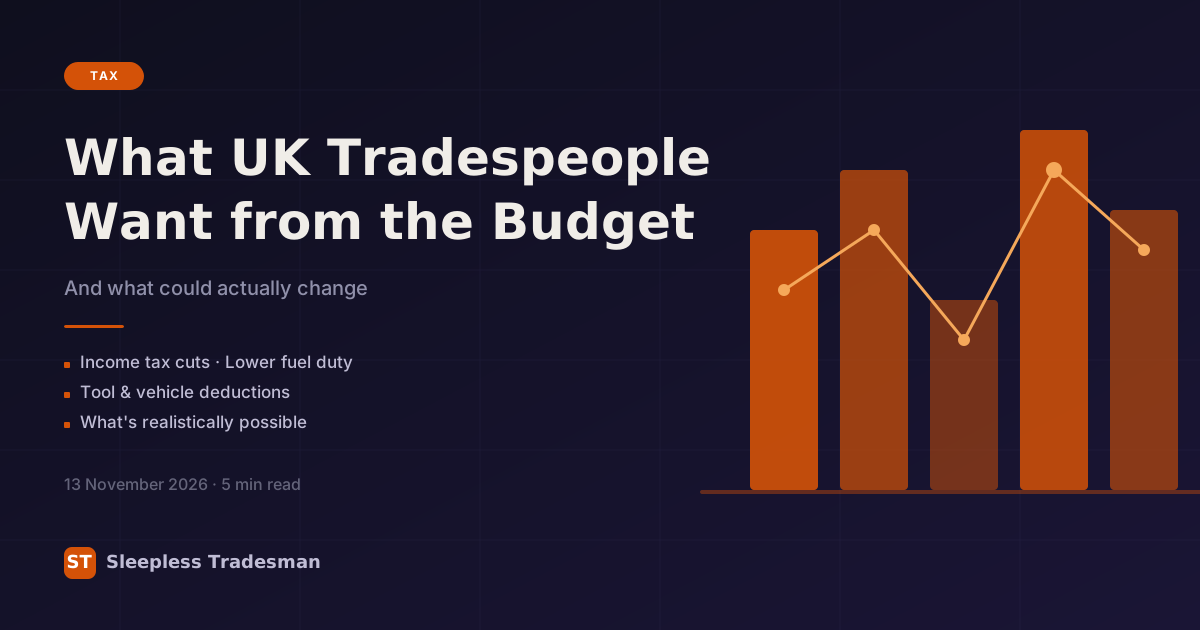
Budget season brings the perennial question: will the government do anything meaningful for self-employed tradespeople? A recent survey of UK tradespeople found clear priorities — 38% want income tax cuts or allowances, 36% want fuel duty reduced, and 35% want better tax deductions for tools and vehicles. Here is what the trades are asking for, what already exists that many tradespeople are not fully using, and an honest assessment of what is likely to change.
What Tradespeople Are Asking For
The survey results paint a consistent picture: the cost of running a trades business has risen faster than day rates, and tradespeople feel the tax system has not kept pace.
| Priority | % of Tradespeople | What They Want |
|---|---|---|
| Income tax relief | 38% | Lower rates or higher allowances for self-employed |
| Fuel duty reduction | 36% | Cut or freeze on petrol and diesel |
| Tools and vehicle deductions | 35% | Better/simpler tax relief on work equipment and vans |
| National Insurance reform | 29% | Lower Class 4 NI for sole traders |
| Simplified MTD compliance | 24% | Less admin burden for quarterly reporting |
The underlying frustration is real: a sole trader electrician or plumber running a van, buying tools, and working long hours often pays a similar effective tax rate to an employee — without sick pay, holiday pay, or employer pension contributions.
What Already Exists (That You Might Be Missing)
Before hoping for budget changes, it is worth knowing the reliefs that are already available and are frequently underused.
Annual Investment Allowance (AIA)
The AIA allows you to deduct the full cost of qualifying plant and machinery in the year you buy it, rather than spreading it over several years. This covers:
- Vans (commercial vehicles, not cars)
- Power tools, hand tools, test equipment
- Scaffolding, ladders, access equipment
- Computers, tablets, printers used for work
- Workshop equipment
Current limit: £1,000,000 per year (this limit has been permanent since April 2023).
If you bought a £25,000 van and £5,000 of tools this year, you can deduct the full £30,000 from your profits — not over several years, immediately. Many sole traders are still using the simpler simplified expenses method for vehicles (which is legitimate but sometimes less beneficial for high-mileage tradespeople).
Allowable Expenses You Can Deduct
HMRC allows deduction of genuine business expenses including:
- Van running costs: fuel, insurance, servicing, repairs, tyres, road tax, MOT, parking
- Tools and equipment: purchase, repair, and replacement
- Workwear and PPE: boots, overalls, hi-vis, hard hat (not ordinary clothing)
- Phone: the business proportion of your mobile bill
- Professional subscriptions: trade body memberships, gas safe registration, NICEIC registration
- Training and CPD: costs of courses and qualifications directly related to your trade
- Accountancy fees
The key condition is that the expense is "wholly and exclusively" for business purposes. A van used for personal journeys creates a private use adjustment — but tools used only for work are fully deductible.
Simplified Expenses for Vehicles
If you use your vehicle for both work and personal use, you can use HMRC's simplified mileage rate (45p per mile for the first 10,000 miles, 25p thereafter) instead of claiming actual costs. This avoids the need to apportion private use but can be less beneficial for tradespeople who drive high business mileage in an expensive vehicle.

What Has a Realistic Chance of Changing?
Being honest about what is likely:
Fuel duty: possible freeze, unlikely cut
Fuel duty has been frozen at 57.95p per litre since 2011, with the 5p temporary cut introduced in 2022 extended multiple times. A further extension of the 5p cut is the most likely outcome at any given budget — an outright reduction is less likely given fiscal constraints.
Tool and equipment relief: probably no change needed
The AIA at £1 million already provides full expensing for virtually everything a sole trader or small contractor buys. The practical issue is not the law — it's that many tradespeople do not know about AIA or are not claiming it properly through their accountant. No budget change is needed here; better awareness is.
Income tax: structural change unlikely short-term
The government has committed to no increases in income tax, NI, or VAT rates. A cut would be welcome but is fiscally difficult. The more likely route for tradespeople is a gradual unfreezing of the personal allowance (currently £12,570, frozen until 2028), which has been eroded by inflation.
MTD simplification: active lobbying area
Several industry bodies are actively lobbying HMRC to reduce the quarterly update burden — specifically to allow annual submission for lower-income self-employed people. This is an area where change is genuinely possible and is under active review.
How to Maximise What Already Exists
Rather than waiting for budget changes, the most impactful action for most tradespeople is to ensure they are claiming everything they are entitled to:
- Use AIA for all equipment purchases — if your accountant is using the standard 18% writing-down allowance instead of AIA, ask why
- Keep receipts for everything — tools, materials, PPE, fuel, subscriptions
- Claim training costs — courses directly related to your trade are allowable
- Review your vehicle arrangement — owned vs leased, actual costs vs mileage rate
- Use the profit margin calculator to understand your effective cost structure before quoting
The gap between what most tradespeople claim and what they are legally entitled to claim is often larger than any budget change would deliver.
Frequently Asked Questions
Can I claim tools as a tax deduction?
Yes. Tools used exclusively for work are fully deductible as a business expense. Under the Annual Investment Allowance (AIA), you can deduct the full cost of tools in the year of purchase — up to £1,000,000 per year. Keep receipts and ensure your tools are listed on your tax return under plant and machinery.
Is fuel for my van tax deductible?
Yes. If you use your van solely for business, all fuel costs are deductible. If you use the same vehicle for personal journeys, you need to apportion the costs — either using the HMRC mileage rate (45p/mile for the first 10,000 miles) or by calculating the business proportion of actual costs. Pure commercial vans are treated differently to cars for tax purposes, usually more favourably.
What is the Annual Investment Allowance and do I qualify?
The AIA lets sole traders and partnerships deduct the full cost of qualifying equipment (vans, tools, machinery) in the year of purchase, up to £1 million. Virtually all self-employed tradespeople qualify. It applies to new and second-hand equipment. It does not apply to cars (only commercial vehicles), land, or buildings. If you are not using it, speak to your accountant.
Make tax simpler
Sleepless Tradesman automatically tracks your earnings and expenses — ready for your accountant or MTD submission.
Try It FreeRelated Guides
Free resources from our UK tradesperson guide library