MTD Quarterly Deadline November 2026: What to Do If You Missed It
The MTD quarterly deadline passed on 7 November 2026. If you missed it, here's what actually happens, how the points-based penalty system works, and what to do before the next deadline on 7 February 2027.
Written by Tom Ellis · Senior Trades Editor
Last updated: 14 November 2026
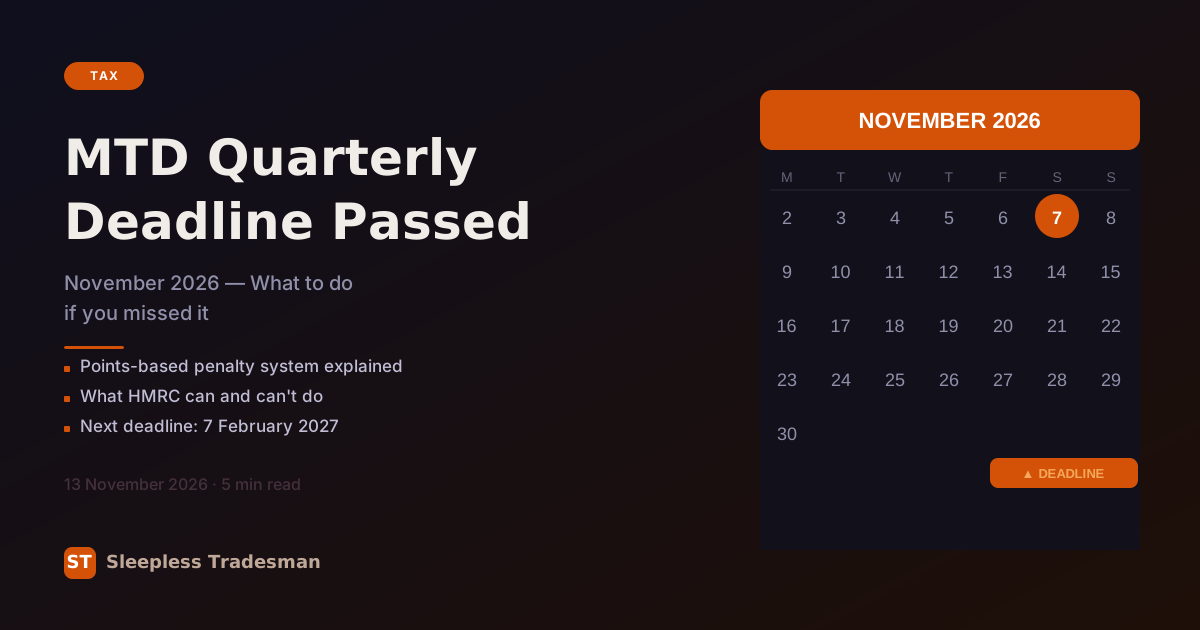
The second MTD for Income Tax quarterly deadline of the 2026/27 tax year passed on 7 November 2026. If you are self-employed or a landlord earning over £50,000 and you missed it, you are not alone — IPSE estimates around 300,000 people missed the first deadline in April. Here is what happens next and how to avoid a repeat.
What Are MTD Quarterly Deadlines?
Making Tax Digital for Income Tax (MTD for ITSA) requires self-employed people and landlords above the income threshold to submit quarterly updates to HMRC using MTD-compatible software. These are not full tax returns — they are summaries of your income and expenses for each three-month period.
The four quarterly deadlines for the 2026/27 tax year are:
| Quarter | Period Covered | Deadline |
|---|---|---|
| Q1 | 6 April – 5 July 2026 | 7 August 2026 |
| Q2 | 6 July – 5 October 2026 | 7 November 2026 ✓ passed |
| Q3 | 6 October – 5 January 2027 | 7 February 2027 |
| Q4 | 6 January – 5 April 2027 | 7 May 2027 |
You also need to submit a final declaration (replacing the old Self Assessment return) by 31 January 2028 for the 2026/27 tax year.
What Happens If You Missed the 7 November Deadline?
HMRC uses a points-based penalty system for MTD late submissions — not an immediate fine. Here is how it works:
- Each missed quarterly submission adds 1 penalty point to your account
- Once you reach 4 points, HMRC issues a £200 fixed penalty
- Each subsequent late submission after reaching the threshold triggers another £200 penalty
- Points expire after 24 months of full compliance
Missing one or two deadlines does not automatically mean a fine. The system is designed to catch persistent non-compliance rather than penalise occasional mistakes.
However, the points do accumulate. If you missed the April deadline and now the November one, you are at 2 points — halfway to the fine threshold.
What about interest on late payments?
The quarterly updates themselves do not involve paying tax — they are reporting only. Any tax owed is settled via the final declaration and payment deadline (31 January 2028 for 2026/27). Late payment of tax still attracts HMRC's standard interest charges, currently at 7.5% per annum above base rate.
Who Is Affected by MTD Right Now?
| Income Threshold | MTD Becomes Mandatory |
|---|---|
| Self-employed or landlord income over £50,000 | April 2026 (already live) |
| Self-employed or landlord income over £30,000 | April 2027 |
| Self-employed or landlord income over £20,000 | April 2028 (proposed) |
If your income is between £30,000 and £50,000, you are not yet required to use MTD — but April 2027 is four months away. Getting set up now is significantly easier than scrambling at the threshold.
What to Do Right Now
1. Submit the missed Q2 update as soon as possible
Log in to your MTD-compatible software and submit your Q2 figures (6 July – 5 October 2026) immediately. HMRC's systems accept late quarterly updates — the point is logged but the submission is still recorded.

If you are not yet using MTD-compatible software, you need to sign up and get set up before submitting. HMRC maintains a list of approved software providers on GOV.UK.
2. Check your penalty points balance
You can view your current penalty points through your HMRC online account or via your accountant. Knowing where you stand helps you understand the urgency.
3. Set a calendar reminder for 7 February 2027
The Q3 deadline (covering October–January) falls on 7 February 2027. That is 87 days from today. Set a reminder now — missing three deadlines in a row puts you one submission away from a fine.
4. Consider using software that automates the submission
The main reason people miss MTD deadlines is that the quarterly update slips down the priority list. Accounting apps that connect to your bank feed and automatically categorise income and expenses make the quarterly update a 10-minute job rather than a half-day scramble.
A Note for Tradespeople Approaching the £30,000 Threshold
If your self-employed income is between £30,000 and £50,000, April 2027 is your MTD start date. You will need:
- MTD-compatible accounting software registered with HMRC
- Your income and expenses recorded digitally throughout the year
- Quarterly submissions from 6 April 2027 onwards
Starting a few months early — even informally — makes the transition much smoother. The MTD eligibility checker on Sleepless Tradesman can confirm whether you need to act now or in April.
Frequently Asked Questions
What is the penalty for missing an MTD quarterly deadline?
Missing one quarterly deadline adds 1 penalty point to your account. There is no immediate fine. Only when you reach 4 points does HMRC issue a £200 penalty. Points expire after 24 months of full compliance. The system is designed to penalise persistent non-compliance rather than occasional missed deadlines.
Can I still submit a late MTD quarterly update?
Yes. HMRC accepts late quarterly submissions. You will receive a penalty point, but the submission is still recorded and your record shows as filed. Submit as soon as possible to avoid accumulating further points.
What is the next MTD quarterly deadline after November 2026?
The Q3 deadline is 7 February 2027, covering the period 6 October 2026 to 5 January 2027. The final Q4 deadline is 7 May 2027.
I earn under £50,000 — do I need to do anything now?
If your self-employed or rental income is below £50,000, MTD is not yet mandatory for you. However, if your income is between £30,000 and £50,000, you must comply from April 2027. Use the MTD checker tool to confirm your position and start preparing.
Not sure whether MTD applies to you? Use the free MTD eligibility checker to check your position in under two minutes.
Make tax simpler
Sleepless Tradesman automatically tracks your earnings and expenses — ready for your accountant or MTD submission.
Try It FreeRelated Guides
Free resources from our UK tradesperson guide library