Future Homes Standard 2027: What It Means for Gas Engineers, Electricians and Builders
The Future Homes Standard takes effect for new homes with planning permission from 24 March 2027. Gas boilers cannot meet the carbon targets for new builds. Here's what it means for gas engineers, electricians and builders — and what to do now.
Written by Tom Ellis · Senior Trades Editor
Last updated: 14 November 2026
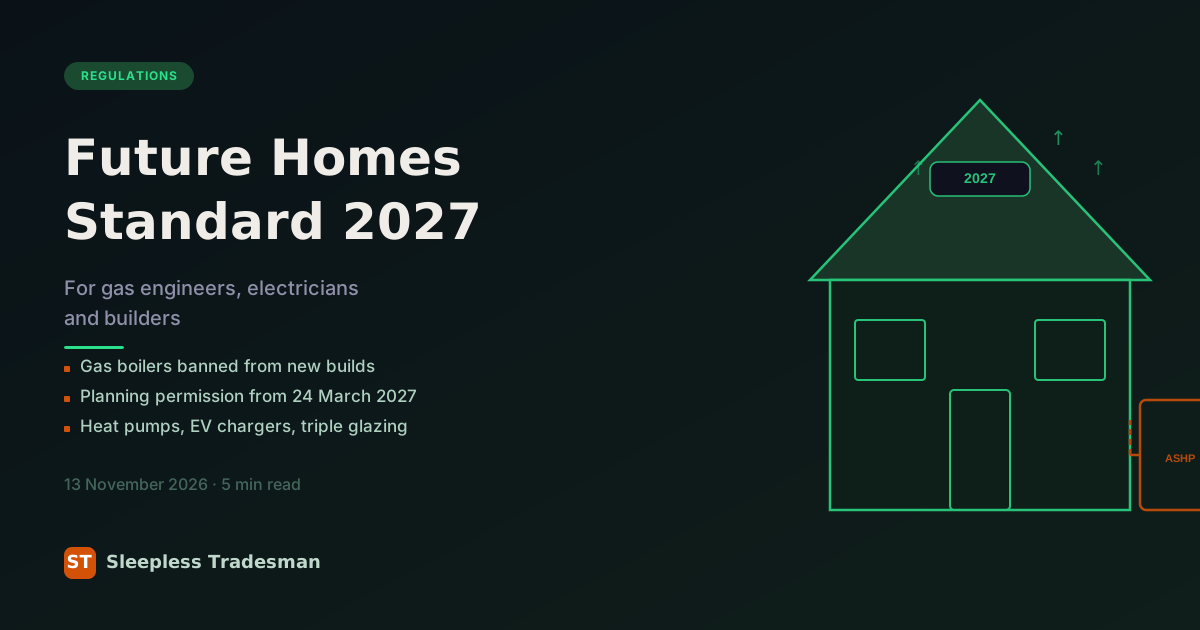
The Future Homes Standard (FHS) was published on 24 March 2026 and takes effect for all new homes receiving planning permission from 24 March 2027 — four months away. For the UK trades industry, this is the most significant change to building regulations for new residential construction in a generation. Here is what it means for each trade.
What Is the Future Homes Standard?
The Future Homes Standard is a package of changes to Part L (conservation of fuel and power) and Part F (ventilation) of the Building Regulations in England. Its aim is to ensure new homes produce 75–80% fewer carbon emissions than homes built to the 2013 standards.
The standard applies to new dwellings receiving full planning permission on or after 24 March 2027. Homes already in planning or under construction before that date are not affected.
Key requirements:
- Fabric-first approach (high insulation, thermal bridging limits)
- Low-carbon heating systems (gas boilers do not meet the carbon targets)
- Mechanical ventilation with heat recovery (MVHR) in many designs
- Solar photovoltaic panels (mandated from 2028)
- EV charging infrastructure for all new homes
Why Gas Boilers Don't Work for New Builds From 2027
This is the headline that gas engineers need to understand. Under the new carbon metrics, a gas combi boiler combined with a gas hob — however efficient — cannot achieve the emissions intensity required by the Future Homes Standard. The maths simply does not work at the carbon factor assigned to gas (0.21 kg CO₂/kWh for natural gas vs 0.136 for electricity on a greening grid).
This does not mean gas is banned in existing homes or even in all new builds immediately — it means that for homes receiving planning permission from 24 March 2027, gas boilers will not satisfy the SAP calculation required for Building Regulations sign-off.
Compliant heating options for FHS new builds:
- Air source heat pumps (most common)
- Ground source heat pumps
- Heat networks (district heating)
- Direct electric heating with high-performance fabric (smaller homes)
- Hydrogen-ready boilers (contingent on hydrogen network roll-out — not yet a compliant pathway)
Impact by Trade
Gas Engineers
The immediate impact on gas engineers in new build work is significant. Heat pump installations are the primary replacement, and the skills overlap is partial — pipework and hydronic systems transfer, but refrigerant handling, F-Gas certification, and heat pump commissioning are additional competencies.
What to do now:
- Consider F-Gas certification if you don't already hold it (required for refrigerant handling in heat pumps)
- Look at MCS (Microgeneration Certification Scheme) accreditation — required for heat pump installations that qualify for the Boiler Upgrade Scheme (BUS) grant
- Courses: BPEC and City & Guilds both offer heat pump pathways
Existing homes (retrofit market) remain a strong gas market for the foreseeable future — the boiler ban applies only to new builds. The 29 million existing gas-heated homes still need servicing, breakdowns attended to, and boilers replaced. That market is not going away in the next decade.
Electricians
The FHS creates significant new electrical work in new residential construction:
- EV charging: Every new home must have a dedicated EV charge point circuit (at least 7 kW capable)
- Heat pump circuits: ASHP typically draws 3–5 kW at peak, requiring a dedicated circuit and appropriate consumer unit capacity
- MVHR wiring: Mechanical ventilation units need dedicated circuits and controls
- PV systems: Solar panels (mandated from 2028) require DC installation, inverter wiring, generation meter, and export connection
- Smart metering and controls: Increased demand for smart home integration, Zappi-style smart chargers, and demand management
This is a volume opportunity. The number of new homes being built may be flat, but the electrical content per new home increases substantially under FHS.
Builders and General Contractors
The fabric-first approach means more rigorous insulation specifications, airtightness testing, and thermal bridging mitigation at junctions. Key changes:
- Airtightness target: 5 m³/h/m² at 50 Pa (tighter than previous Part L)
- Psi values: Thermal bridging at wall/floor/roof junctions must be calculated and documented
- Airtightness testing: Mandatory pressure test on completion
- MVHR ductwork: More complex internal ductwork routes to integrate with the ventilation system
Main contractors will need to plan service routes and ductwork coordination earlier in the build programme.
Solar Panels: Mandatory from 2028
The 2027 FHS standard does not mandate solar PV as a universal requirement — but revised guidance expected in 2028 is widely anticipated to do so. Many housebuilders and local planning authorities are already specifying PV as a condition of planning approval ahead of that date.
For electricians, MCS accreditation for solar PV installation is worth considering now. The MCS 001 and MCS 012 standards cover installer requirements, and accreditation typically takes 3–6 months from application.
Key Dates Summary
| Date | What Happens |
|---|---|
| 24 March 2026 | Future Homes Standard published |
| 24 March 2027 | FHS applies to new homes with planning permission from this date |
| 2028 (expected) | Solar PV mandate likely introduced |
| Ongoing | Hydrogen-ready boiler pathway under review by DESNZ |
Frequently Asked Questions
Does the Future Homes Standard affect existing homes?
No. The FHS applies only to new dwellings receiving planning permission from 24 March 2027. Existing homes are governed by existing Part L requirements. Boiler replacements in existing properties are not affected — gas boilers remain a viable replacement option in the existing housing stock.
Can I still install a gas boiler in a new build after March 2027?
Not in a way that satisfies the Building Regulations SAP calculation for a standard new build. Gas boilers cannot achieve the required carbon intensity under the new metrics. Some very unusual cases (off-grid properties, specific building types) may have alternative compliance routes — but for mainstream new residential construction, gas boilers are effectively out from March 2027.
What certification do I need to install heat pumps?
To install heat pumps commercially, you need F-Gas certification (handling refrigerants), and for installations that qualify for the Boiler Upgrade Scheme grant, MCS accreditation through an MCS-registered company. BPEC, City & Guilds, and Vaillant's Advance Academy all offer approved heat pump training pathways.
Does this apply in Scotland, Wales and Northern Ireland?
No. Building regulations are devolved. The Future Homes Standard applies only in England. Scotland has its own Heat in Buildings Strategy, Wales has the Future Wales National Plan, and Northern Ireland has separate building regulations. Each jurisdiction is moving towards low-carbon heating but on different timelines and frameworks.
Ready to work smarter?
Join the tradespeople using AI to save time on quotes, invoices, and job planning.
Try Sleepless Tradesman FreeRelated Guides
Free resources from our UK tradesperson guide library