EICR Qualification Changes: What UK Electricians Need to Know After October 2026
The experience-only route to carrying out Electrical Installation Condition Reports closed on 1 October 2026. UK electricians without the right qualification are now legally unable to sign off EICRs. Here's exactly what changed and your options.
Written by Tom Ellis · Senior Trades Editor
Last updated: 14 November 2026
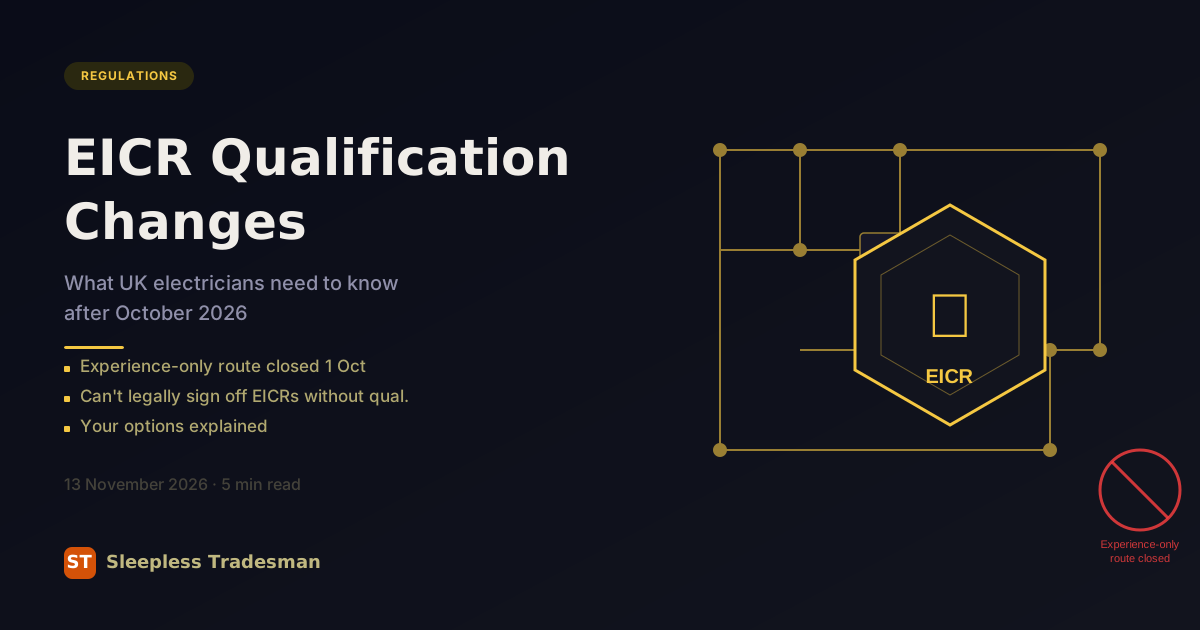
The electrical industry reached a significant compliance milestone on 1 October 2026: the experience-only route to conducting Electrical Installation Condition Reports (EICRs) officially closed. If you have been carrying out EICRs based on experience alone — without a formal Level 3 qualification — you are no longer legally permitted to do so. Here is what changed, who it affects, and what your options are.
What Is an EICR?
An Electrical Installation Condition Report is a formal assessment of the safety of an electrical installation in an existing building. It is required:
- Every 5 years for rented residential properties (or on change of tenancy)
- Every 3–5 years for commercial properties
- When a property is sold or significantly altered
Only a competent person — as defined by the electrical competent person schemes — can conduct and sign off an EICR. Before October 2026, "competent" could be demonstrated through documented experience alone. That route has now closed.
What Changed on 1 October 2026?
The Joint Industry Board (JIB), ECA, NICEIC and other scheme operators updated their competence requirements in line with the Electrotechnical Assessment Specification (EAS). The key change:
Before 1 October 2026: Electricians could demonstrate EICR competence through a portfolio of documented experience, without needing a specific qualification.
From 1 October 2026: To conduct EICRs, electricians must hold:
- A relevant Level 3 qualification in periodic inspection and testing, AND
- At least 2 years of documented experience carrying out inspection and testing work
The experience-only pathway has been permanently removed.
Which qualifications now satisfy the requirement?
| Qualification | Awarding Body | Notes |
|---|---|---|
| Level 3 Award in the In-Service Inspection and Testing of Electrical Equipment (2391-51) | City & Guilds | Covers portable appliance testing |
| Level 3 Award in Periodic Inspection, Testing and Certification of Electrical Installations (2391-52) | City & Guilds | The main EICR route |
| Level 3 Certificate in Inspection, Testing and Certification (2391-50) | City & Guilds | Combined unit covering both |
| EAL Level 3 Award in Periodic Inspection and Testing | EAL | Accepted by most schemes |
The 2391-52 (or the combined 2391-50) is the qualification most directly relevant to EICRs on fixed installations.
Who Is Affected?
The change primarily affects electricians who:
- Have been conducting EICRs for years but never formally qualified
- Hold older qualifications that pre-date the current Level 3 framework
- Are registered with a competent person scheme under the previous experience-route criteria
If you are already registered with a scheme and hold a valid Level 3 qualification, nothing changes for you.
If you are registered but were relying on experience only, you will need to contact your scheme operator. NICEIC, NAPIT, and ELECSA each have transition guidance on their websites outlining deadlines for existing registrants.
What Happens If You Carry Out an EICR Without the Qualification?

Signing off an EICR without meeting the new competence requirements creates serious liability:
- Your competent person scheme registration may be revoked
- The EICR report may be legally invalid, exposing landlords and your customers to risk
- If a fault is missed and causes injury or fire, your insurance may refuse to cover a claim
- In rented properties, an invalid EICR could put landlords in breach of the Electrical Safety Standards in the Private Rented Sector (England) Regulations 2020
This is not a technicality — it is a liability issue.
How to Get Qualified
The 2391-52 qualification is widely available through training providers across the UK. However, demand has surged following the October deadline, and many providers are reporting waiting lists of 8 to 12 weeks for course starts.
Where to look:
- ECA Training (eca.co.uk/training) — ECA-approved centres across England and Wales
- JIB (jib.org.uk) — joint industry board recognised providers
- NICEIC (niceic.com) — approved training centres for NICEIC-registered electricians
- Local colleges — many FE colleges run City & Guilds 2391 programmes
Cost: Typically £350 to £600 for the 2391-52 Award, depending on the provider and whether assessment is included.
Duration: Most courses are 2 to 4 days of taught content plus a practical assessment.
If you need to conduct EICRs while waiting for a course place, the safest route is to partner with a qualified electrician who can countersign reports — confirming in writing that this is a temporary arrangement while you complete your qualification.
Frequently Asked Questions
I've been doing EICRs for 15 years — do I really need to qualify now?
Yes. The experience-only route has closed. Your practical knowledge is valuable, but the formal qualification is now a legal requirement to sign off EICRs under the revised EAS competence framework. Contact your scheme operator to confirm your specific situation, as some schemes had a transition window for long-standing registrants.
Can I still carry out inspection and testing work without the qualification?
You can carry out inspection and testing work, but you cannot sign off and certify an EICR report without the Level 3 qualification and documented experience. If you are working under the supervision of a qualified electrician who countersigns, the reports remain valid — but this is a short-term measure while you get qualified.
How long does the City & Guilds 2391-52 take?
The qualification typically requires 2 to 4 days of taught content followed by a practical assessment. Most candidates complete it within 4 to 6 weeks from starting, though current waiting lists for course places are running at 8 to 12 weeks from enquiry.
Does this affect PAT testing?
Portable appliance testing (PAT) has a different pathway (2391-51 or equivalent). The October 2026 changes primarily affect the fixed installation EICR pathway. Check with your competent person scheme for the full picture on PAT competence requirements, as these are also being reviewed.
Ready to work smarter?
Join the tradespeople using AI to save time on quotes, invoices, and job planning.
Try Sleepless Tradesman FreeRelated Guides
Free resources from our UK tradesperson guide library