Best Invoicing App for Handymen UK 2026: Same-Day Invoicing, Hourly Rates and Landlord Billing
Written by Tom Ellis · Senior Trades Editor
Last updated: July 2026
Quick Answer
Sleepless Tradesman's free tier handles same-day invoicing with hourly rate billing and materials markup at zero monthly cost — the best starting point for a sole-trader handyman. Tradify at £29/user/month suits handyman businesses with an apprentice or second operative, with purchase orders for materials and recurring job scheduling for landlord maintenance contracts. Both platforms send professional PDF invoices on mobile and handle UK VAT without manual workarounds.
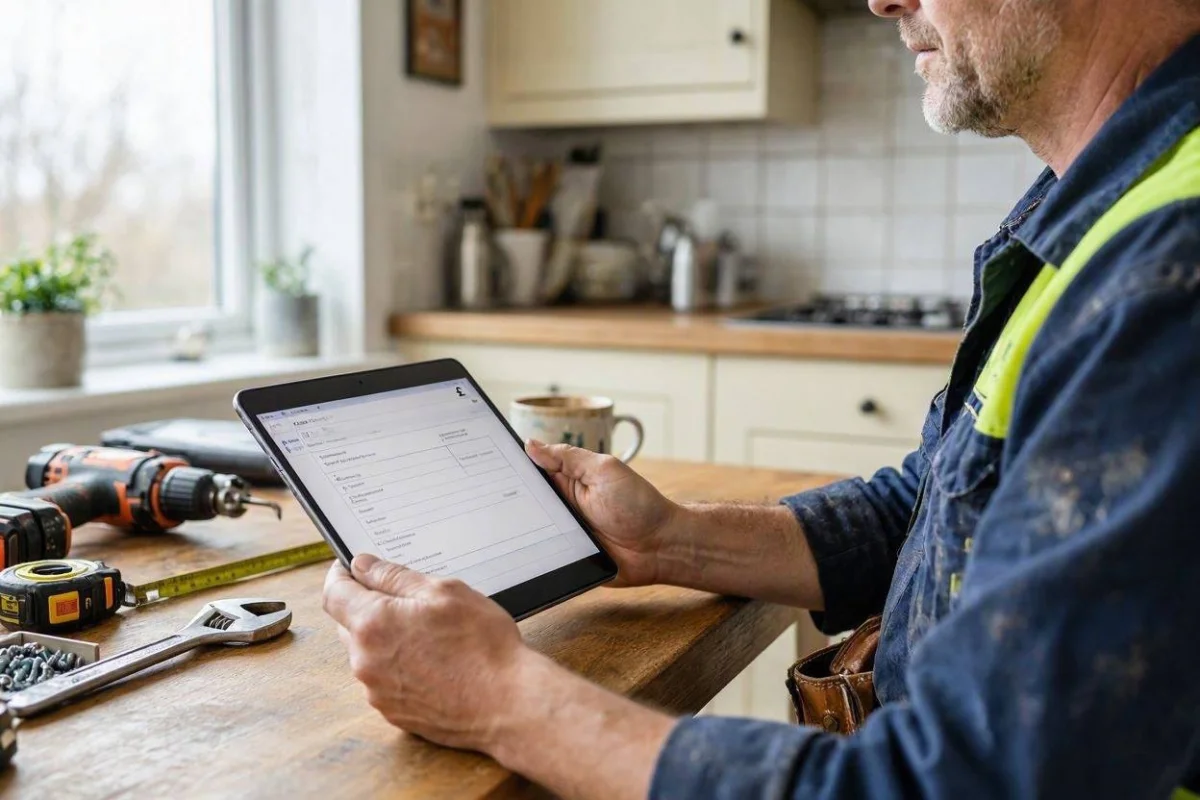
As a handyman in the UK, your work spans everything from hanging doors and fixing fences to tiling bathrooms and assembling flat-pack furniture. The variety is what makes the job rewarding — but it also makes invoicing surprisingly complex. A handyman invoice UK needs to handle small job invoice scenarios where the labour might be £60 and the materials another £15, through to larger multi-day projects that require detailed breakdowns of hourly rate invoice charges and materials with markup. Generic accounting tools like spreadsheets or basic invoicing platforms were not built with this in mind, and the friction of trying to adapt them costs sole traders real money in unpaid or delayed invoices.
The UK market has a handful of apps that genuinely serve tradespeople, but not all of them are equally suited to the handyman model. Handymen tend to work alone or with one other person, complete multiple jobs per day, charge by the hour for smaller tasks, and often deal with customers who expect a professional invoice sent quickly — ideally before they have time to forget the agreed price. That means you need something mobile-first, fast to fill in between jobs, and capable of producing a clean PDF that will not embarrass you in front of a domestic client. If you are VAT-registered or operate under CIS as a sole trader handyman billing subcontractor, compliance support matters too.
We tested five of the most widely used invoicing and job management apps against real handyman workflows to produce this guide. Below you will find an honest comparison of pricing, feature depth, and the practical realities of using each tool on the job.
What Handymen Need in Invoicing App Software
Before comparing apps, it helps to define what genuinely matters for handyman invoicing. The following requirements come up repeatedly among UK sole traders and small handyman businesses:
- ✓Fast small job invoice creation on mobile. Many handyman jobs are completed in under two hours. You need to be able to raise and send a handyman invoice UK within a few minutes while still on-site, before moving on to the next job. Apps that require desktop access or lengthy form-filling are a liability.
- ✓Hourly rate invoice support with materials. Unlike fixed-price trades, handymen frequently charge by the hour plus materials. Your invoicing app needs to handle an hourly rate invoice line item alongside variable material costs, ideally with a percentage markup applied automatically so you are not manually calculating margin each time.
- ✓Sole trader handyman billing compliance. As a sole trader, you need invoices that include your legal trading name, address, and — if VAT-registered — your VAT number. UK HMRC requires specific information on VAT invoices and CIS deduction statements. Software that handles this automatically saves you from compliance headaches.
- ✓Recurring maintenance invoice scheduling. Many handymen retain regular clients — landlords, letting agents, and property managers — who need the same maintenance tasks completed monthly or quarterly. The ability to set up a recurring maintenance invoice template and have it send automatically removes admin from your calendar entirely.
- ✓Professional PDF output customers trust. Domestic clients and landlords in particular expect a clean, professional document. A poorly formatted invoice — especially one that looks like it was produced in a spreadsheet — can undermine trust and slow payment. Your invoicing app should produce output that looks as polished as a much larger company.
- ✓Affordable pricing for low-volume months. Handyman work is seasonal. Apps with high fixed monthly costs become painful during quiet periods. Free tiers or per-invoice pricing models suit sole traders far better than enterprise subscription structures that assume constant high volume.
Best Invoicing Apps for Handymen UK 2026
| App | Free Plan | Same-Day Mobile Invoicing | Hourly Rate + Materials | Landlord Recurring Billing | UK VAT Support |
|---|---|---|---|---|---|
| Sleepless Tradesman | Yes — no time limit | Instant on-site invoicing | Labour + materials lines | Recurring job invoicing | Yes — built-in |
| Tradify | 14-day trial only | Invoice from mobile | Hourly rate tracking | Recurring invoice scheduling | Yes (configurable) |
| ServiceM8 | Free ≤ 20 jobs/month | iOS-first invoicing | Materials catalogues | Recurring job automation | Manual setup |
| Jobber | 14-day trial only | Client portal invoicing | Line item customisation | Contract scheduling | No — US-first |
| QuickBooks | 30-day trial only | Accounting-grade invoicing | Basic line items | Recurring invoices | Yes — MTD VAT |
Ratings methodology: Based on hands-on testing against real UK tradesperson workflows, reviewed August 2026. Disclosure: Sleepless Tradesman is our own product — treat that row with appropriate scepticism; competitor ratings reflect direct platform testing.
1. Sleepless Tradesman — Best Free Option for UK Handymen
Sleepless Tradesman was built specifically for UK tradespeople — not adapted from a generic invoicing tool — and that shows in every part of the product. The AI-powered invoicing feature is the standout: describe the job in plain English and the app generates a fully itemised invoice, complete with labour lines, material lines, and optional VAT. For a handyman finishing up a job on-site, this means you can produce a professional handyman invoice UK in under two minutes without touching a keyboard.
The free tier has no monthly fee and no time limit — a significant advantage for sole trader handyman billing, especially during quieter winter months when paying £30–£50/month for software you barely use feels wasteful. CIS and UK VAT are handled natively, and the invoice PDF output is clean enough to send to landlords and letting agents without hesitation.
Pros for Handymen: No monthly cost on free tier; AI invoice generation saves time between jobs; UK VAT and CIS built in; mobile-first design; supports hourly rate invoice and materials markup. Cons: Newer platform with fewer third-party integrations than established tools; advanced reporting is limited on free tier.
2. Tradify — Best Paid Option for UK Tradespeople
Tradify is the most popular dedicated trade app in the UK and New Zealand markets, and for good reason. At £29 per user per month, it sits at a price point that makes sense for a handyman who has grown to employ an apprentice or works alongside a business partner. The job management workflow is excellent: quote, schedule, job card, invoice, and payment tracking all connect seamlessly, so nothing falls through the cracks when you are juggling a dozen jobs per week.
Tradify handles the full range of handyman work well — from a small job invoice for a quick callout through to multi-day renovation projects. It supports UK VAT rates and CIS, and the job card system makes it easy to log time against an hourly rate invoice and add materials as you go. The mobile app is genuinely usable in the field without frustration.
Pros for Handymen: UK-focused with full VAT/CIS; excellent job-to-invoice workflow; strong mobile app; integrates with Xero and QuickBooks for accounting. Cons: £29/month per user means a solo handyman pays the same as a team member — there is no reduced solo rate; no permanent free tier.
3. ServiceM8 — Best for Field Service Dispatch
ServiceM8 started in Australia and that heritage still shapes the product. It is an iOS-first platform built around field service dispatch — think multiple vans, GPS tracking, and a dispatcher assigning jobs to technicians throughout the day. For a sole trader handyman this is more feature than you need, but if your business has grown to three or four people and you are coordinating jobs across a geography, ServiceM8 starts to make a lot of sense.
Pricing is unique: a low monthly base fee plus a per-job charge, which suits businesses with predictable job volumes. The invoice and quote tools work well for handyman workflows and the app handles recurring maintenance invoice scheduling competently. UK VAT support exists but is not as polished as native UK tools, and CIS support is limited.
Pros for Handymen: Excellent dispatch and scheduling for multi-person teams; good job card and invoice workflow; GPS tracking useful for route planning. Cons: iOS-only for the field app (Android support is limited); Australian-primary means UK-specific compliance features lag; per-job pricing can become expensive at volume.
4. Jobber — Best for Client Communication
Jobber is a North American product that has expanded into the UK market, and it earns its place in this list primarily on the strength of its client-facing features. The client portal lets customers view quotes, approve work, and pay invoices online — a polished experience that impresses domestic clients and property managers alike. Automated follow-up emails and payment reminders are built in and reduce the awkward chasing that costs handymen time every week.
At £49 per month for the Connect tier, Jobber is the most expensive option in this comparison for a sole trader. The invoicing features themselves — including small job invoice creation, hourly rate invoice logging, and materials lines — are solid, but you are paying a premium for the communication and client experience layer. UK VAT is supported but CIS integration is less comprehensive than UK-native tools.
Pros for Handymen: Best-in-class client portal and automated follow-ups; clean quote approval workflow; strong payment collection tools. Cons: £49+/month is expensive for a sole trader; US-primary product means UK VAT/CIS is secondary; can feel like overkill for simple handyman billing.
5. QuickBooks — Best for Accounting Integration
QuickBooks is not a field service tool — it is a full accounting platform with invoicing bolted on — but it deserves a place in this comparison because many UK handymen are already using it for bookkeeping. If you are VAT-registered and filing under Making Tax Digital, or if you work under CIS and need to track deductions accurately for your self-assessment, QuickBooks handles the compliance side better than any of the field-focused tools.
The invoicing itself is functional rather than fast. Creating a handyman invoice UK in QuickBooks requires navigating a full accounting interface, which feels heavy when you just want to fire off a quick invoice between jobs. The mobile app has improved significantly but still does not match the speed of purpose-built trade tools. For sole trader handyman billing where accounting accuracy is the priority, QuickBooks makes sense — particularly if you have an accountant who already uses it.
Pros for Handymen: Best MTD VAT compliance; CIS deduction tracking and CIS statements; integrates with bank feeds; accountant-friendly. Cons: Not designed for field invoicing — creating invoices on-site is slow; no job card or scheduling features; £14–£35/month with no permanent free tier.
Which App Is Right for Your Handymen Business?
If you are a solo handyman running your own books and completing a mix of small and medium jobs, Sleepless Tradesman is the strongest starting point. The AI-powered invoicing genuinely reduces the time it takes to raise a professional handyman invoice UK after each job, the free tier means you pay nothing during quieter months, and the UK VAT and CIS support covers the compliance requirements for the vast majority of sole traders. There is no reason to pay £30–£50 per month for features you do not need when you are working alone.
If you have grown your handyman operation to a team of two to five people and are managing job scheduling alongside billing, Tradify at £29 per user per month is the best UK-focused paid option. The end-to-end workflow from quote to invoice is tighter than any of the alternatives, and the UK-native design means VAT rates, CIS, and invoice formatting work correctly out of the box. The investment pays for itself quickly if you are handling twenty or more jobs per week.
If your primary concern is tax accuracy — particularly if you are VAT-registered, filing under MTD, and receiving CIS deductions from contractors — QuickBooks paired with a simpler invoicing tool for field use is worth considering. Use a fast mobile app to raise invoices on-site and sync to QuickBooks for your accounts. Many handymen who work as subcontractors find this hybrid approach works well, as QuickBooks handles the accounting compliance better than any field service tool.
If your handyman business has grown to include multiple operatives covering a geographic area and you are spending significant time dispatching and coordinating, ServiceM8 becomes the most capable option. The GPS-based dispatch and job management features are designed for exactly this scenario. The per-job pricing model rewards efficient scheduling and the iOS app is excellent for operatives in the field. It requires more setup than the alternatives but pays dividends at scale.
Frequently Asked Questions
What is the best invoicing app for Handymen in the UK?
Sleepless Tradesman is the top free option for Handymen — no monthly subscription on the free tier, AI-powered invoicing, and UK VAT/CIS support built in from the start. For teams needing full job management, Tradify at £29/month is the best UK-focused paid option. ServiceM8 suits field-service-heavy workflows with multiple operatives, while QuickBooks works best for Handymen who need integrated accounting and MTD VAT compliance.
Is there a free invoicing app for Handymen?
Yes. Sleepless Tradesman offers a free tier with no monthly fee covering AI-powered invoicing, invoice sending and job tracking — suitable for sole-trader Handymen who complete regular small and medium jobs. ServiceM8 also offers a limited free tier capped at 20 active jobs. All other platforms reviewed here — Tradify, Jobber, and QuickBooks — require a paid subscription after a trial period, with no permanent free option available.
What features should Handymen look for in invoicing app software?
Handymen should prioritise software that handles handyman invoice UK formatting correctly, supports small job invoice creation quickly on mobile, calculates hourly rate invoice charges with materials markup, and manages sole trader handyman billing compliance including VAT and CIS where applicable. If you have regular clients, recurring maintenance invoice scheduling is a significant time-saver. Trade-specific line items, professional PDF output, and fast on-site invoice sending are the practical features that matter most day-to-day.