UK Construction PMI Fell to 43.6 in October — But Here's Why 2027 Looks Different
UK construction activity contracted further in October, with the PMI falling to 43.6. But there are early signs the pipeline is building. Here's what the data means for tradespeople and how to position your business for the recovery expected in 2027.
Written by Tom Ellis · Senior Trades Editor
Last updated: 14 November 2026
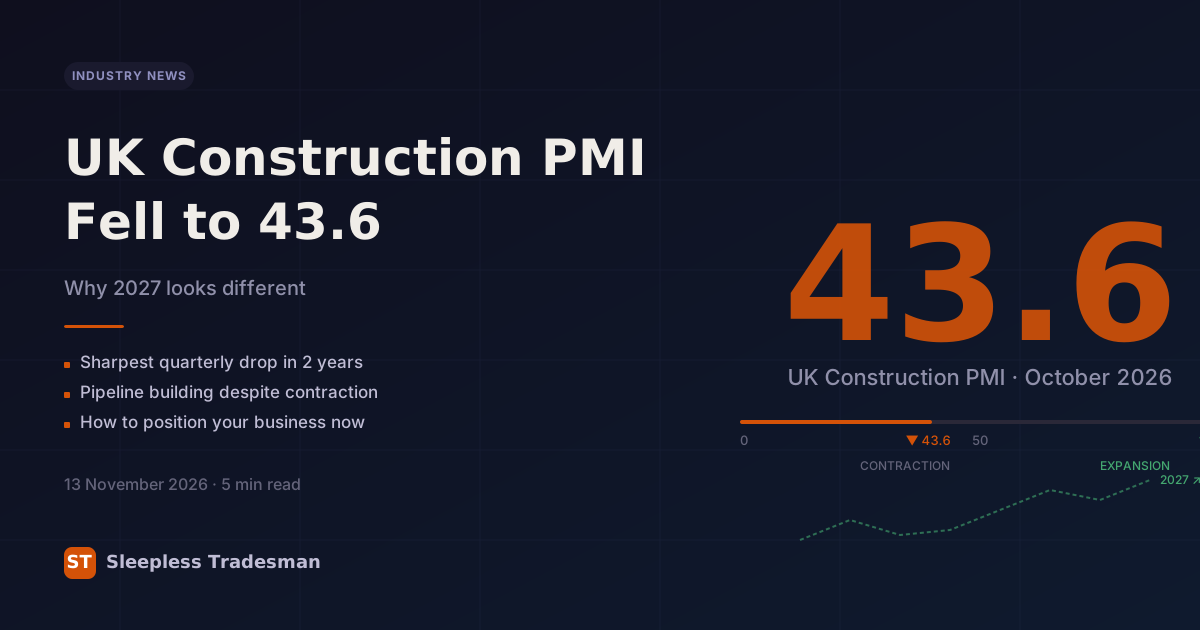
The S&P Global / CIPS UK Construction PMI fell to 43.6 in October 2026, down from 46.1 in September. Any reading below 50 indicates contraction — October was the sixth consecutive month below that threshold, confirming that the UK construction sector is in a sustained downturn.
But buried in the same data is an important counterpoint: new orders in Q3 exceeded Q2, and the forward pipeline is quietly building. Here is what the numbers mean for tradespeople and self-employed contractors.
What the PMI Reading Actually Means
The Purchasing Managers' Index (PMI) is a monthly survey of purchasing managers across the construction industry. It measures output, new orders, employment, supplier delivery times, and input costs. A reading above 50 = expansion; below 50 = contraction.
October 2026 headline figures:
| Metric | October Reading | Direction |
|---|---|---|
| Overall Construction PMI | 43.6 | ↓ from 46.1 |
| Civil Engineering | 41.2 | Weakest sub-sector |
| Commercial Construction | 42.8 | Still contracting |
| Housebuilding | 44.1 | Slowest since mid-2023 |
| New Orders | 45.3 | Contracting but improving |
| Future Activity Index | 51.7 | Above 50 — optimism returning |
The Future Activity Index at 51.7 is the most encouraging data point. This measures expectations for the next 12 months. It has been above 50 for two consecutive months — the first time since early 2025.
What Is Driving the Contraction?
Commercial and civil sectors
Large commercial development and civil infrastructure projects have been held back by high financing costs, planning delays, and uncertainty around public spending commitments. The government's infrastructure pipeline has been revised multiple times in 2025–26, leaving contractors reluctant to scale up capacity.
Housebuilding
New housebuilding output hit its lowest level since mid-2023 in October. Planning permissions are recovering slowly — up 8% in Q3 vs Q2 — but the lag between permission and construction start means the volume benefit won't reach subbies and specialist trades until late 2027 at the earliest.
Materials costs still elevated
Building materials inflation is running at around 6.4% year-on-year (DBT, September 2026), with structural steel up 21% and rigid pipes and fittings up 15.5%. Elevated material costs are compressing margins on fixed-price contracts and causing some projects to be deferred.
The Counterargument: Why 2027 Could Be Different
Despite the weak headline, several leading indicators are pointing towards recovery:
1. New orders are building a pipeline Q3 new order volumes exceeded Q2 for the first time in 18 months. This doesn't translate to activity immediately — there is typically a 3–6 month lag — but it suggests work coming through in Q1/Q2 2027.
2. Planning permissions recovering Residential planning permissions were up 8% in Q3 2026 vs Q2, and commercial permissions up 5%. The government's Planning and Infrastructure Bill, expected to receive Royal Assent in early 2027, is designed to accelerate the approval process further.

3. Glenigan's 2027 forecast Construction industry analyst Glenigan is projecting a 4% recovery in construction output in 2027, led by housebuilding and energy transition infrastructure (heat networks, solar farms, EV charging infrastructure). That is modest, but it represents a turning point after two years of contraction.
4. Interest rate trajectory The Bank of England has cut base rate to 3.75% as of October 2026. Further cuts are expected in Q1 2027. Lower borrowing costs reduce the cost of development finance and typically feed through to construction starts within 6–9 months.
What This Means for Tradespeople Right Now
A contracting market is harder than a growing one. Here is how to navigate it:
Win more of the work that is out there
When fewer projects are running, the tradespeople who win work are those who quote fastest and present themselves most professionally. An AI quoting tool that gets an accurate estimate in front of a customer within hours — rather than days — converts at a significantly higher rate than a competitor who takes a week to quote.
Protect your margins
Material cost inflation means that quotes from 2024 are almost certainly underpriced. Revisit your material allowances and use current trade prices. The profit margin calculator can help you check whether your jobs are actually profitable at current input costs.
Use the quieter period to get qualified
Training courses for in-demand qualifications (heat pump installation, EV charging, solar PV, EICR) are easier to get onto during a downturn than during a boom. Tradespeople who come into the 2027 recovery with FHS-relevant qualifications will be in a significantly stronger position.
Frequently Asked Questions
Does the PMI fall mean there is less work for tradespeople?
Not necessarily less work — but it is more competitive. The PMI measures the rate of change across the whole sector, including large commercial and infrastructure projects. Residential maintenance, repair and improvement (MRI) work is less affected by the commercial downturn. Most sole traders and small contractors work predominantly in the residential market, which is contracting less sharply than the commercial sector.
When is the construction sector expected to recover?
Glenigan and the Construction Products Association both project a modest recovery in 2027, with stronger growth expected from 2028 as the housing pipeline rebuilds. The key driver will be the planning reform pipeline translating into new housing starts. Energy transition work (heat pumps, solar, EV infrastructure) is growing now regardless of the broader cycle.
How do I protect my business during a construction slowdown?
Focus on three things: win rate (quote faster and more accurately), margin protection (revisit material allowances in your pricing), and diversification (if your work is concentrated in one sector or one or two clients, the slowdown is higher risk). Admin efficiency — getting invoices out fast, chasing payments, keeping costs visible — matters more in a tight market than a growing one.
Don't let changes catch you out
Sleepless Tradesman keeps your documents and invoices compliant. Set up in 2 minutes, no contract.
Get Started FreeRelated Guides
Free resources from our UK tradesperson guide library
Related Articles
 Industry News
UK Construction Output Falls: What It Means for Tradespeople's Pipelines in 2026
UK Trades Skills Shortage: 317,000 Workers Needed by 2030 — What It Means for You
 Industry News