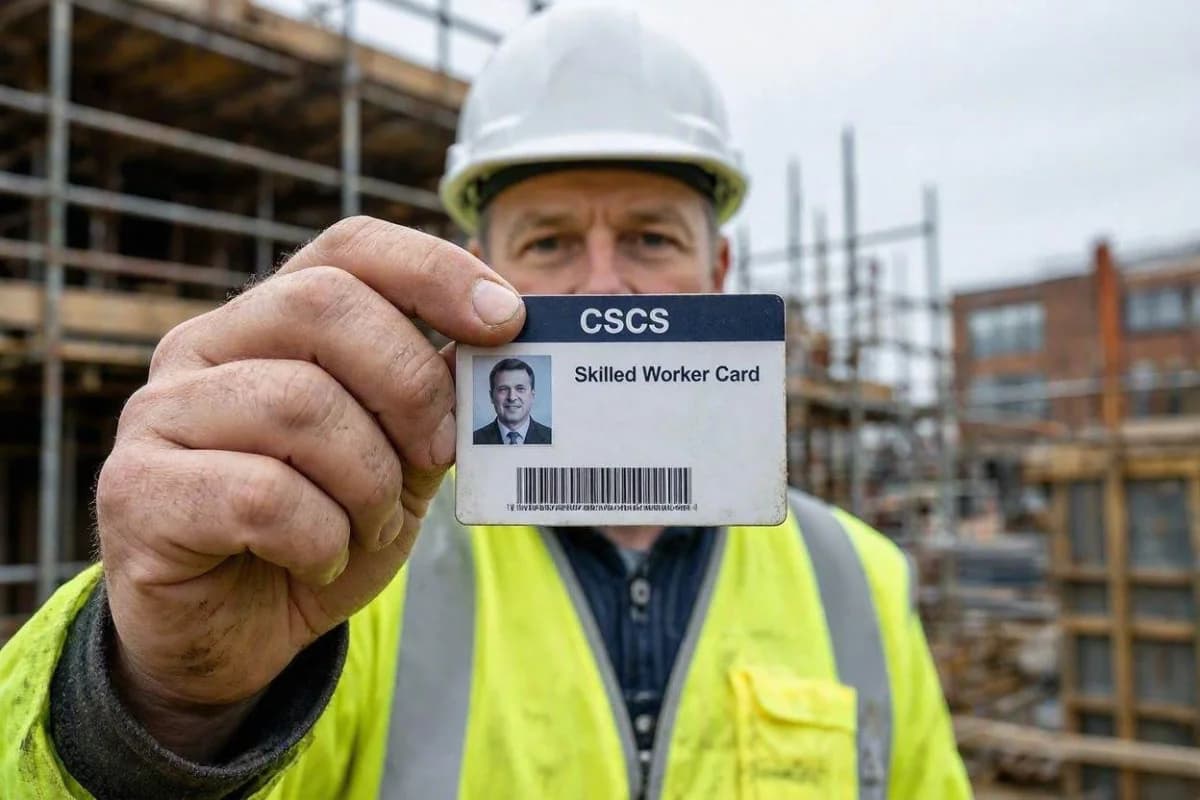
CSCS Red Card UK 2026: Labourer Card Requirements, Cost and How to Get One
Written by Tom Ellis · Senior Trades Editor
Last updated: August 2026
Quick Answer
The CSCS red card (officially the CSCS Labourer card) is the most commonly held CSCS card in the UK construction industry. It confirms that the cardholder has passed the CSCS Health, Safety and Environment (HS&E) test for Operatives and is approved to work on construction sites as a general labourer. The card costs £36 and is valid for five years. Unlike the CSCS blue, gold or green cards, the red card does not require an NVQ or trade qualification. It is purely qualification-based on the HS&E test alone.
Quick wins
- Book the HS&E Operative test at a Pearson VUE test centre before applying for the card.
- The test costs £22.50 and the card application costs £36, budget around £58.50 in total.
- Study using the free CSCS revision app or the official CITB revision guide before your test.
- Apply online at cscs.uk.com immediately after you pass; cards arrive within five working days.
- The red card does not require an NVQ or any trade qualification, so it is the fastest CSCS card to obtain.
What is the CSCS red card?
The Construction Skills Certification Scheme (CSCS) runs a tiered card system that covers most occupations on UK construction sites. The red card sits at the entry level of this hierarchy. Its full official name is the CSCS Labourer card, though it is almost universally called the red card because of the colour of the physical card.
CSCS is a voluntary scheme, but in practice the vast majority of UK construction sites now require every worker to hold a valid CSCS card as a condition of site access. Major contractors including Balfour Beatty, Laing O'Rourke, Kier and Morgan Sindall, as well as most local authority frameworks, mandate CSCS cards for all site-based workers. Without a card, you are likely to be turned away at the gate on any commercial construction project in England, Scotland, Wales or Northern Ireland.
The red card was specifically designed for workers whose role is general labouring rather than a skilled trade. If you carry materials, assist specialist tradespeople, maintain site cleanliness or perform general manual duties on site, the red card is the appropriate card for your occupation. It was not intended as a permanent qualification level for most workers and CSCS actively encourages red card holders to progress to a higher card level once they have completed a relevant NVQ or apprenticeship.
For a broader overview of all card types within the scheme, see our companion guide: CSCS card types UK: which card do you need?
What work does a red card allow you to do?
The CSCS red card is valid for general labouring duties on construction sites across the UK. These duties typically include moving and stacking materials, operating wheelbarrows and small plant under supervision, assisting bricklayers, joiners, plumbers and other tradespeople, keeping sites clean and clear of debris, operating barrier systems and signing in visitors, and supporting groundworks operations such as trenching assistance and backfill.
The red card does not authorise you to carry out the work of a recognised skilled trade. For example, a red card holder could assist a plumber by fetching fittings and preparing work areas, but could not independently install pipework. If you progress into a trade and gain the appropriate NVQ, you should upgrade to the relevant blue (Skilled Worker) or gold (Advanced Craft) card.
It is also worth noting that the red card does not cover supervision. Site supervisors and managers need either a gold card (for experienced craft workers moving into supervision) or the black CSCS Manager and Professional card. If your role involves managing or supervising labour directly, speak to CSCS about the correct card for your level of responsibility.
CSCS red card requirements 2026
The red card has the simplest requirements of any occupational CSCS card. There is one mandatory step: you must pass the CSCS Health, Safety and Environment (HS&E) test for Operatives. This is the entry-level HS&E test administered by CITB (Construction Industry Training Board) through Pearson VUE test centres. No NVQ, no apprenticeship, no prior work experience and no employer sponsorship is required.
| Requirement | Detail | Cost (2026) |
|---|---|---|
| HS&E Operative test | Booked and sat at a Pearson VUE centre | £22.50 |
| CSCS Labourer card application | Applied online at cscs.uk.com | £36.00 |
| Total estimated cost | £58.50 |
You must be at least 16 years old to hold a CSCS card. There is no upper age limit. You will need a valid form of photographic ID when you sit the test at the Pearson VUE centre, typically a passport or driving licence. The same ID should be used consistently when you apply for the card online, as CSCS may cross-reference the details.
The HS&E Operative test: what to expect
The CSCS Health, Safety and Environment test for Operatives is a 45-question multiple-choice test delivered on a computer terminal at any of the hundreds of Pearson VUE test centres across the UK. You have 45 minutes to complete it. The pass mark is set by CITB and is typically around 45 correct answers out of 50 for the behavioural case study section and a separate threshold for the core knowledge section, though CITB can adjust the pass mark periodically.
The test covers six topic areas: working safely, working at height, fire prevention and control, health and welfare, manual handling, and environmental awareness and waste control. Questions are drawn from the CITB revision book for Operatives, which is available to purchase directly from CITB for around £5, or to revise using the free CITB HS&E test app available on iOS and Android.
The test is also available in several languages other than English, including Polish, Romanian, Punjabi, Urdu and Welsh, which makes it accessible to workers across the UK's diverse construction workforce. You must request an alternative language when booking through Pearson VUE.
To book the test, visit citb.co.uk or the Pearson VUE website and search for test centres near you. Major test centre locations include London, Birmingham, Manchester, Leeds, Glasgow, Cardiff, Belfast, Bristol, Nottingham, Sheffield and Edinburgh, with many additional centres in smaller towns and cities. Most candidates can find an available slot within one to two weeks of booking.
If you fail the test on your first attempt, you must wait two days before rebooking and paying again. There is no limit on the number of attempts. Most candidates pass on their first attempt when they have studied the revision material.
Your test result is valid for two years from the date of the test. You must apply for your CSCS card within this two-year window. If your result expires before you apply, you will need to sit the test again.
How to apply for your CSCS red card
Once you have passed the HS&E Operative test, applying for the CSCS Labourer card is straightforward. Follow these steps in order.
Step 1: Pass the HS&E Operative test
Book and sit the CSCS Health, Safety and Environment test for Operatives at a Pearson VUE test centre. You need a pass certificate before you can apply for the card. On the day, bring valid photographic ID. The test costs £22.50 and takes up to 45 minutes. You will be told your result immediately at the test centre. If you pass, you will receive a pass letter either on the day or by post within a few days. Keep this letter safe as you will need your unique test reference number during the card application.
Step 2: Go to cscs.uk.com and start your application
Visit the official CSCS website at cscs.uk.com and navigate to the card application section. You can apply online 24 hours a day, seven days a week. You will need to create an account or log in if you already have one. Select the Labourer card from the card type options. Do not select a different card type by mistake as refunds are not automatic and delays can occur if you apply for the wrong card.
Step 3: Enter your personal details and test reference
Complete the application form with your full name, date of birth, address and contact details. You will be asked to enter your HS&E test reference number so that CSCS can verify your pass result directly with the CITB database. Make sure the name and date of birth you enter exactly match the details you used when booking the HS&E test, as any discrepancy will cause your application to be held for manual review, which can delay the card by several weeks.
Step 4: Upload a passport-style photograph
The CSCS card is a photo ID card, so you need to provide a clear, recent passport-style photograph during the online application. The photograph should show your full face against a plain light background, with no hats or sunglasses. The CSCS website accepts JPEG and PNG files. Use good lighting and a recent photo. Poor quality or rejected photographs are one of the most common causes of application delays, so take a moment to get this right.
Step 5: Pay the £36 card fee
The CSCS Labourer card costs £36 as of 2026. Payment is accepted by credit or debit card through the secure CSCS online portal. There is no option to pay by bank transfer or invoice. Once payment is confirmed, your application is submitted and you will receive an email confirmation. Keep this email as proof of your application in case you need to follow up.
Step 6: Receive your card within five working days
CSCS posts the physical card to the address you provided during the application. Standard delivery takes up to five working days after approval. If you have not received your card after ten working days, contact CSCS on 0344 994 4777 with your application reference number. The card arrives in a plain envelope by Royal Mail first-class post. There is no tracked delivery option for standard applications.
Cost, validity and renewal
The CSCS red card is valid for five years from the date of issue. Your card will display a clear expiry date on the front. Site managers and security personnel on UK construction sites routinely check card expiry dates, so it is important to track when your card expires and begin the renewal process in good time.
To renew a red card, you must pass the HS&E Operative test again before applying. There is no exemption for existing holders. The renewal process is identical to the initial application: book and pass the test, then apply online at cscs.uk.com and pay the £36 renewal fee. CSCS recommends starting the renewal process at least three months before your card expires to avoid any gap in site access.
If your card has already expired, you can still renew it using the same process. An expired card is not valid for site access, but your previous CSCS history is retained on the CSCS register when you renew. Site managers can verify card validity in real time using the free CSCS Smart Check app, which is available on iOS and Android and reads the QR code on the back of the card.
| Card detail | Information |
|---|---|
| Card fee (2026) | £36 |
| HS&E test fee (2026) | £22.50 |
| Validity period | 5 years |
| Delivery time | Up to 5 working days |
| Application method | Online only at cscs.uk.com |
| NVQ required? | No |
| Employer sponsorship needed? | No |
Red card vs blue card: what is the difference?
The red card (Labourer) and the blue card (Skilled Worker) are the two most commonly held CSCS cards in UK construction. The key difference is that the blue card requires both the HS&E test and a relevant NVQ Level 2 or equivalent qualification in a recognised construction trade. The red card only requires the HS&E test.
| Feature | Red card (Labourer) | Blue card (Skilled Worker) |
|---|---|---|
| HS&E test required? | Yes | Yes |
| NVQ or qualification required? | No | Yes (NVQ Level 2 or equivalent) |
| Card fee | £36 | £36 |
| Validity | 5 years | 5 years |
| Covers skilled trade work? | No | Yes |
| Time to obtain | Days to weeks | Months to years (NVQ completion) |
If you are a trained tradesperson, the red card is not the right card for you even if it is quicker to obtain. Most construction sites in 2026 expect skilled workers to hold the blue card appropriate to their trade. Holding a red card when you are working as a plumber, electrician or carpenter can raise questions with site managers and may affect your ability to access all areas of larger commercial projects.
For full detail on all card colours and what they mean, see our guide: CSCS blue card: requirements and how to get one.
Frequently asked questions
How long does it take to get a CSCS red card?
The fastest route is around one to two weeks from start to finish. Booking a Pearson VUE test centre slot usually takes a few days to a week depending on local availability. Once you pass the HS&E Operative test, you apply online at cscs.uk.com and the physical card arrives by post within five working days. In urgent cases, some applicants have received a card within a week of passing the test.
Can I work on a construction site without a CSCS card?
There is no law in the UK that legally requires workers to hold a CSCS card. However, the vast majority of commercial construction sites in England, Scotland, Wales and Northern Ireland contractually require a valid CSCS card as a condition of site access. In practice, if you do not hold a valid card you will be turned away from most sites. Some small domestic construction sites and private projects do not enforce this, but it is the exception rather than the rule.
What is the difference between the CSCS red card and the CSCS green card?
The CSCS green card is formally known as the CSCS Labourer card for those enrolled in an NVQ or formal construction training programme. Some people confuse it with the red card, but they are distinct. The green card is intended as a temporary card for trainees and apprentices actively working towards a qualification. The red card is for permanent general labourers who are not working towards a formal qualification. For more detail, read our guide: CSCS green card: requirements and how to apply.
Can I get a CSCS red card if I am self-employed?
Yes. There is no requirement for employer sponsorship to apply for a CSCS red card. Self-employed general labourers apply in exactly the same way as employed workers: book and pass the HS&E Operative test, then apply online at cscs.uk.com and pay the £36 fee. The card is issued in your own name and is yours to keep regardless of who you work for.
What happens if my CSCS red card expires?
An expired CSCS red card is not valid for site access. You will need to renew it before returning to site. The renewal process requires you to pass the HS&E Operative test again and then submit a new application online. There is no grace period. CSCS recommends starting the renewal at least three months before expiry to avoid gaps. Site managers can verify whether your card is current using the CSCS Smart Check app.
Is the CSCS HS&E test available online or from home?
No. The CSCS Health, Safety and Environment test must be sat in person at an approved Pearson VUE test centre. There is no remote or online-only option as of August 2026. You can book your slot online via the CITB website or the Pearson VUE website, but you must attend the test centre in person on the day with valid photographic ID.
Running jobs and managing your work as a tradesperson?
Sleepless Tradesman helps UK tradespeople manage quotes, jobs and client communication in one place. Free to try, no card required.
Try Sleepless Tradesman freeRelated guides
Methodology and disclosure: costs and requirements in this guide reflect CSCS and CITB published figures as of August 2026. Card fees and test prices are set by CSCS and CITB respectively and may change. Always verify current fees at cscs.uk.com and citb.co.uk before applying. Sleepless Tradesman has no commercial relationship with CSCS, CITB or Pearson VUE and receives no commission for applications made via external links in this guide.